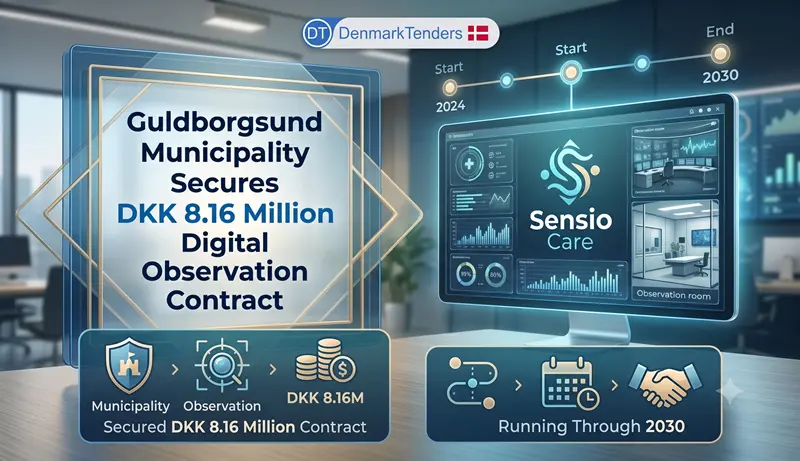
Guldborgsund Municipality Secures DKK 8.16 Million Digital Observation Contract with Sensio Care Through 2030
15 Jul 2026
Guldborgsund Municipality - DKK 8.16M Digital Observation Contract Guldborgsund Municipality in Denmark has awarded a contract worth up to DKK 8.16 million for the delivery and operation of a Digital Observation solution to Sensio Care ApS. The deal, signed on 7 July 2026, covers a cloud-based subscription solution for anonymised supervision, event detection and support for night and safety visits across the municipality's care centres, with particular focus on screened wards and temporary care places, reflecting the municipality's commitment to digital welfare and elderly care innovation. Introduction Every care facility depends on reliable observation systems to ensure resident safety and efficient workflows. When those systems need to be modern, cloud-based and integrated with emergency call solutions, the procurement decisions become strategic. In Guldborgsund Municipality, that responsibility now rests with Sensio Care ApS, after the Danish local authority signed off on a new Digital Observation contract worth up to DKK 8.16 million over up to six years. It is not a headline-grabbing infrastructure deal. But it is the kind of contract that keeps elderly care running efficiently and safely, and it says a great deal about how Danish municipalities are approaching digital transformation in the welfare sector. Why This Contract Matters Denmark's municipalities face a demographic challenge: an ageing population and increasing demand for care services, combined with pressure on public finances. Digital observation solutions offer a way to maintain safety and quality of care while using resources more efficiently. This contract is a textbook example of how municipalities are leveraging technology to address these challenges. For the supplier, that means one competitive process can open the door to a stable, long-term relationship with a municipal client. For the municipality, it means access to modern, cloud-based technology that improves care quality and staff efficiency. Contract Timeline Contract award notice published: 15 July 2026 (OJ S 134/2026) Winner chosen: 25 June 2026 Contract concluded: 7 July 2026 Coverage start date: 1 August 2026 Coverage end date: 31 July 2030 Maximum renewals: 2 x 12 months Maximum total term: 72 months (6 years) Contract Overview Guldborgsund Municipality ran an open procedure under EU Directive 2014/24/EU, receiving four tenders. The result is a direct contract (not a framework agreement) covering the delivery and operation of a Digital Observation solution. The contract covers a subscription-based solution including: Implementation of all necessary equipment, software, SIM cards, technical infrastructure and administration systems Operation and maintenance of a comprehensive cloud-based solution for digital observation and digital supervision Anonymised digital supervision with image display, two-way communication and event detection (falls, presence and movement) Ongoing updates, maintenance and replacement of equipment Support for integration with the municipality's emergency call solution The solution is designed for use at the municipality's care centres, with the possibility of application in home care. The municipality has planned the installation and commissioning of 250 digital observation units. Key Contract Details Detail Information Contracting authority Guldborgsund Kommune Winning bidder Sensio Care ApS Contract subject Digital Observation (surveillance system), CPV 35125000 Procedure type Open procedure Legal basis EU Directive 2014/24/EU Estimated value (excl. VAT) DKK 13,000,000 Value of contract awarded DKK 8,161,200 Initial term 1 August 2026 – 31 July 2030 (4 years) Maximum term 72 months (incl. 2 renewals of 12 months) Bids received 4 EU funding None disclosed Covered by GPA No Winner chosen 25 June 2026 Contract signed 7 July 2026 Project Scope The contract covers a subscription-based Digital Observation solution for Guldborgsund Municipality. The scope includes: Equipment and software - Implementation of all necessary hardware, software, SIM cards and technical infrastructure Cloud-based solution - A modern, reliable and coherent cloud-based solution for digital observation and supervision Anonymised supervision - Digital supervision with image display, two-way communication and event detection Event detection - Detection of falls, presence and movement Integration - Full integration with the municipality's emergency call solution (nødkaldsløsning) Ongoing maintenance - Regular updates, maintenance and equipment replacement Continuous improvement - Ongoing evaluation and improvement based on user feedback and technological advances Specific focus areas: Screened wards (skærmede afsnit) Temporary care places (midlertidige døgnophold pladser - MDO) Night and safety visits (natte- og tryghedsbesøg) The municipality plans to install and commission 250 digital observation units. Options included in the contract: Option 1: Delivery and operation of up to 50 additional subscriptions during the contract period Option 2: Up to six courses during the contract period after implementation for new employees (face-to-face training in Guldborgsund Municipality with up to 15 employees per course) About the Contracting Authority Guldborgsund Kommune is a municipality in the Region of Zealand in Denmark, with its administrative centre in Nykøbing Falster. It was formed in 2007 through the merger of several smaller municipalities. The municipality is responsible for a wide range of welfare services, including elderly care, health services and social care. This contract reflects the municipality's commitment to using technology to improve care quality and efficiency. The municipality has also signed a separate contract for modernising its emergency call solution (nødkaldsløsning), which will replace alarm systems, sensors and GPS devices. Both solutions must form an integrated whole where emergency calls, staff alarms and digital observation work together. About the Winning Company Sensio Care ApS is a Danish company classified as a small enterprise, specialising in digital welfare technology for the healthcare sector. The company provides solutions for digital observation, supervision and care technology. Further details on the company's operations and product range are not disclosed in the notice. The company's registration number is 20276779. No address or contact details are provided in the notice beyond the company name. Procurement Analysis Procedure: An open procedure was used, meaning any interested supplier could submit a tender. This is the standard route for supply and service contracts where requirements are well-defined. Competition: Four tenders were received. This is a healthy level of competition for a specialised digital welfare technology market in Denmark. Evaluation criteria: Quality carried the dominant weight (80%) compared to price (20%). The evaluation uses a "best price-quality ratio" approach with a pass/fail threshold: each tender must achieve a score of at least 40 points on each evaluation criterion before the internal weighting is calculated. Key evaluation points: Price: 20% Quality: 80% Stopkarakter (threshold): Minimum 40 points required on each evaluation criterion The weighting of quality over price reflects the critical nature of the services: the municipality prioritises solution quality, reliability and user-friendliness over cost alone. Selection criteria (minimum requirements): Financial: Turnover of at least DKK 8 million for each of the last three financial years; equity ratio of at least 15% for the latest financial year Technical: Two comparable references from the last three years for similar digital observation contracts Special exclusion: Contracts cannot be awarded to companies with Russian affiliation, in accordance with Council Regulation (EU) 2025/395 amending Regulation (EU) No. 833/2014 on restrictive measures in response to Russia's actions destabilising the situation in Ukraine. Framework structure: No framework agreement was used. This is a direct contract with a single supplier for the initial four-year term with optional renewals. GPA status: The procurement is not covered by the Government Procurement Agreement (GPA). Additional Procurement Facts The contract includes options for up to 50 additional subscriptions and up to six training courses. The contract is structured as a subscription solution, meaning the municipality pays a recurring fee rather than a one-time capital investment. Full integration with the municipality's emergency call solution is a key requirement. The procedure was not accelerated, indicating a standard timeline was followed. No dynamic purchasing system was used. Disputes or review requests fall to Klagenævnet for Udbud (the Danish Complaints Board for Procurement). No complaints were received during the procurement process. Market & Industry Perspective Digital observation is a growing segment of the Danish welfare technology market. As the population ages and demand for care services increases, municipalities are turning to technology to maintain safety and quality while managing costs. Cloud-based solutions offer advantages in terms of scalability, maintenance and future upgrades. This contract reflects a broader trend in Danish municipal procurement: moving from capital-intensive, on-premise solutions to subscription-based, cloud services. The subscription model allows municipalities to spread costs over time and ensures regular updates and maintenance without additional procurement processes. The integration requirement is also significant. By requiring full integration with the emergency call solution, Guldborgsund Municipality is creating a unified platform for care safety, rather than a collection of separate systems. This approach should improve workflows and reduce complexity for staff. Economic Significance At DKK 8.16 million over up to six years, this contract represents a significant investment in digital welfare technology for a Danish municipality of moderate size. The estimated value of DKK 13 million was not fully utilised, suggesting the municipality achieved good value for money through the competitive process. For Sensio Care ApS, the contract offers predictable revenue and a strong reference in the Danish municipal sector. For Guldborgsund Municipality, the contract provides access to modern, cloud-based observation technology that supports both resident safety and staff efficiency. Future Procurement Opportunities The initial four-year term, with two optional 12-month extensions, means this contract could run through to 2032. The options for additional subscriptions and courses provide flexibility for the municipality to expand the solution if needed. Suppliers not successful in this procurement may look for opportunities in other Danish municipalities, many of which are pursuing similar digital observation and welfare technology initiatives. The integration requirement in this contract may signal a trend toward unified care platforms in Danish municipalities. Opportunities for Suppliers For digital welfare technology providers, the key takeaway is that Danish municipalities are moving toward integrated, cloud-based solutions with quality weighted more heavily than price. Suppliers should focus on demonstrating solution reliability, user-friendliness and integration capabilities. The subscription model also offers opportunities for suppliers to build long-term relationships with municipal clients, rather than one-off sales. Suppliers that can offer comprehensive solutions with regular updates and maintenance may have a competitive advantage. What Businesses Should Watch Whether other Danish municipalities adopt similar integrated, cloud-based solutions for digital observation and emergency calls. The implementation of the integration with the emergency call solution, which could signal future integration requirements. The uptake of options for additional subscriptions, which will indicate the success of the solution and potential for expansion. DenmarkTenders Procurement Intelligence This contract is a useful case study in how Danish municipalities are approaching digital transformation in elderly care. By using a subscription-based, cloud solution with a single supplier, Guldborgsund Municipality gains access to modern technology without the capital burden of a traditional procurement. The quality-weighted evaluation ensures that the municipality gets a solution that meets its needs, rather than simply the lowest price. The integration requirement is particularly significant. By requiring full integration with the emergency call solution, the municipality is creating a unified platform that should improve staff workflows and resident safety. This integrated approach is likely to become more common as municipalities seek to simplify their technology landscapes. The special exclusion of companies with Russian affiliation, while relatively rare in Danish procurement notices, reflects the EU's broader sanctions regime and is likely to become more common in public procurement across Europe. Supplier Takeaways Quality is weighted more heavily than price; suppliers should focus on demonstrating solution quality, reliability and user-friendliness. Integration capabilities are critical; suppliers should be able to demonstrate integration with existing and planned systems. The subscription model requires a focus on ongoing service delivery and customer support. The pass/fail threshold (minimum 40 points) means suppliers must meet minimum quality standards to be considered. Suppliers with Russian affiliation are excluded under EU sanctions regulations. Key Takeaways Guldborgsund Municipality awarded a DKK 8.16 million digital observation contract to Sensio Care ApS. The contract runs for an initial 4 years (August 2026 – July 2030), with two optional 12-month renewals. Four bids were received through an open procedure weighted toward quality (80%) over price (20%). The contract covers a cloud-based subscription solution with 250 observation units, plus options for additional units and training courses. Full integration with the municipality's emergency call solution is a key requirement. The contract is not covered by the GPA and includes exclusion of suppliers with Russian affiliation. Conclusion This is not a high-profile contract, but it reflects something structurally important about how Danish municipalities are approaching elderly care in the digital age. By securing an integrated, cloud-based digital observation solution through a quality-weighted procurement, Guldborgsund Municipality has ensured that its care facilities will be equipped with modern, reliable and user-friendly technology through to 2030. Sensio Care ApS now carries that responsibility for the municipality's residents and staff. Frequently Asked Questions What is digital observation? Digital observation refers to the use of technology, such as cameras and sensors, to monitor residents in care facilities. The solution in this contract includes anonymised supervision with image display, two-way communication and event detection for falls, presence and movement. Q: What is a subscription solution? A subscription solution is a service-based model where the municipality pays a recurring fee for the use of the technology, rather than purchasing equipment outright. The subscription includes equipment, software, maintenance, updates and support. Q: Why integrate with the emergency call solution? Integration creates a unified platform where emergency calls, staff alarms and digital observation work together, simplifying workflows for staff and improving resident safety. Q: What is the stopkarakter (threshold)? Each tender must achieve a minimum score of 40 points on each evaluation criterion. Tenders that do not meet this minimum are excluded, regardless of price. Q: What does the Russian affiliation exclusion mean? Contracts cannot be awarded to companies with Russian affiliation, in accordance with EU sanctions regulations (Council Regulation (EU) 2025/395). Q: Is this contract covered by the GPA? No. The procurement is not covered by the Government Procurement Agreement.Source: EU Official Journal, Notice publication number: 487401-2026, OJ S 134/2026, published 15 July 2026.
View Details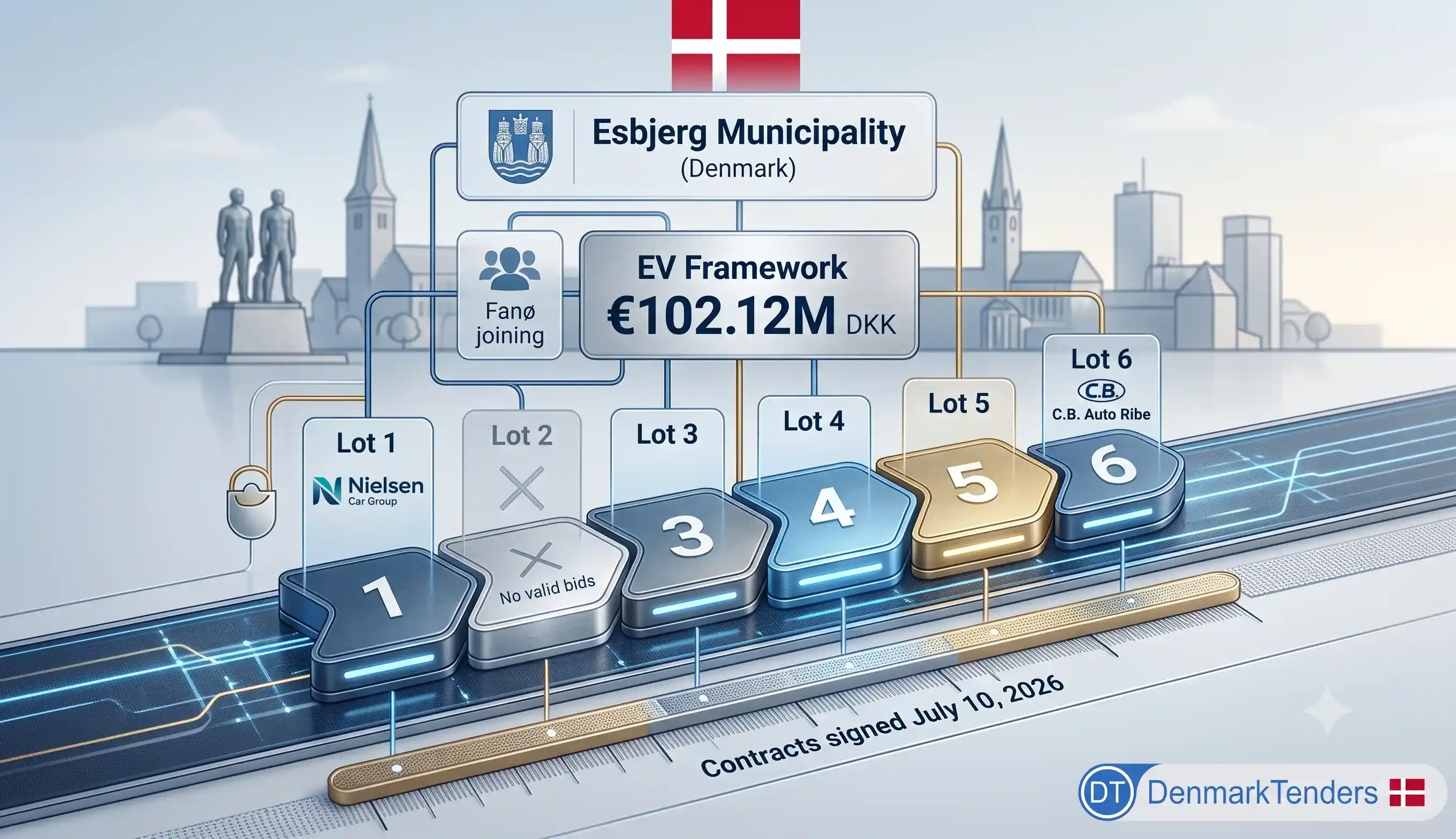
Esbjerg and Fanø Re-Tender Their Electric Vehicle Fleet in a Deal Worth Over 100 Million DKK
14 Jul 2026
Esbjerg Municipality, joined by neighbouring Fanø Municipality, has awarded a re-tendered framework agreement for electric vehicles and related services across six vehicle categories. Nielsen Car Group A/S and C. B. Auto Ribe ApS split the awarded lots between them, while one category, mid-size and large passenger cars, received no valid bids and remains unfilled. Introduction When a public tender fails to produce usable results, a "genudbud", or re-tender, lets the buyer try again. That is exactly what happened in Esbjerg: after an earlier attempt to secure electric vehicles for the municipal fleet, Esbjerg Kommune, acting on behalf of itself and Fanø Kommune, has now re-run the process and secured suppliers for five of six vehicle categories, from small electric cars to chassis-based vehicles used for specialist municipal bodywork. It is a practical, unglamorous contract, but one that directly determines what the two municipalities' staff will be driving over the next year, and how far their fleets shift toward electric power. Why This Contract Matters Danish municipalities are under increasing pressure to electrify their vehicle fleets as part of broader climate commitments. Rather than buying vehicles ad hoc, Esbjerg structured this framework agreement around six distinct vehicle categories, small and large passenger cars, small buses, small and larger vans, and chassis-based vehicles, each separately tendered so specialist suppliers could compete on the categories where they are strongest. The fact that one category needed a full re-tender, and another still failed to produce a usable result even on the second attempt, illustrates the practical difficulty some public buyers face in securing electric vehicle suppliers at the right price and specification. Contract Timeline Original framework notice referenced: 291873-2026 Winners selected: 2 June 2026 (all awarded lots) Contracts concluded: 10 July 2026 Contract award notice published: 14 July 2026 (OJ S 133/2026) Service period begins: 1 August 2026 Contract duration: 1 year, with no renewal options Contract Overview Esbjerg ran an open re-tender procedure ("Genudbud") across six lots, each covering a distinct electric vehicle category under Danish registration classifications M1, N1, and N2. The framework also covers related services, including servicing, fitting of tracking devices, and mounting of logos and test streamers on delivered vehicles. Fanø Kommune is formally attached to the agreement alongside Esbjerg. Five of the six lots received at least one valid bid and were awarded; the second lot, covering mid-size and large passenger cars, received two tenders but both were withdrawn or found inadmissible, leaving that category without a winner. Key Contract Details Project Scope The framework covers electric vehicles across six categories: small passenger cars (up to 5 people), mid-size and large passenger cars, small buses (7 or 9 seats), small vans, mid-size and larger vans, and chassis-based vehicles used for specialist municipal bodywork such as service vehicles. Related services include periodic servicing, installation of GPS tracking units, and fitting of municipal logos and test streamers on delivered vehicles. Buses, trucks, and other vehicle types outside these categories are explicitly excluded from the agreement. Each lot was evaluated on price (40%), warranty terms (20%), and quality as assessed by technical evaluators (40%), applied identically across all six categories. About the Contracting Authorities Esbjerg Kommune is a Danish regional authority responsible for general public services in and around the city of Esbjerg in Sydjylland, acting as group leader for this procurement. Fanø Kommune, a smaller neighbouring municipality, is formally attached to the same framework agreement, allowing it to draw on the same suppliers without running a separate tender. About the Winning Companies Nielsen Car Group A/S, a large dealership group based in Silkeborg, won the two highest-value lots: small passenger cars and mid-size/larger vans, together worth approximately 44.3 million DKK. C. B. Auto Ribe ApS, a large dealer based locally in Ribe, within the Sydjylland region itself, won the remaining three awarded lots: small buses, small vans, and chassis-based vehicles, together worth just under 9.75 million DKK. Neither winner subcontracted any part of their awarded work. Procurement Analysis Procedure: This was a re-tender ("Genudbud") of an original framework procurement, indicating the initial process did not fully succeed in securing suppliers across all categories. Competition: Competition varied significantly by lot, from a single bid for chassis-based vehicles to four bids for small vans, reflecting differing levels of supplier interest and capacity across vehicle categories. Evaluation criteria: Price carried 40% of the weighting, warranty terms 20%, and technical quality assessment 40%, applied consistently across all six lots. Framework structure: Each lot is a framework agreement without reopening of competition, meaning the winning supplier for each category will fulfil orders directly for the one-year term, which carries no renewal options. Unfilled lot: Lot 2, covering mid-size and large passenger cars, received two tenders, but both were withdrawn or ruled inadmissible, leaving the municipalities without a supplier in that category from this process. GPA status: The contracts fall under the World Trade Organization's Government Procurement Agreement, meaning they were, in principle, open to qualifying international bidders, though both winners are Danish companies. Additional Procurement Facts The notice records the total value of all contracts awarded as 102,120,000 DKK, though the sum of the individual lot tender values disclosed in the notice (approximately 54.1 million DKK) is considerably lower; the notice does not explain this difference. The procurement was not financed with EU funds. No dynamic purchasing system was used. Disputes or review requests fall to the Klagenævnet for Udbud (Danish Complaints Board for Public Procurement), with strict statutory deadlines for lodging complaints. Micro, small, or medium enterprises submitted bids for several lots, including small buses, small vans, and mid-size passenger cars, though the winning bidders in each awarded lot were both classified as large enterprises. Market and Industry Perspective Municipal fleet electrification is a recurring procurement theme across Danish local government, and splitting a tender into narrow vehicle categories, as Esbjerg has done here, lets specialist dealers compete for the segments where they hold the strongest supply relationships with electric vehicle manufacturers. The failed lot for mid-size and large passenger cars suggests that category may face tighter supply, pricing, or specification challenges in the current electric vehicle market compared to smaller vehicle classes. For regional dealers like C. B. Auto Ribe, based directly in the contract's own region, proximity and established local servicing capability appear to be a meaningful advantage in categories requiring ongoing maintenance support. Economic Significance Even using the more conservative sum of individual lot values, at roughly 54 million DKK combined, this is a significant fleet investment for two municipalities the size of Esbjerg and Fanø, and it materially advances their transition to electric vehicles across everyday municipal operations, from passenger transport to service and utility vehicles. Future Procurement Opportunities With no renewal options built into this one-year framework, Esbjerg and Fanø will need to return to the market for a further tender once the current term ends, giving both incumbent winners and other suppliers, including whoever eventually fills the vacant mid-size/large passenger car category, a fresh opportunity to compete. Opportunities for Suppliers Vehicle dealers and fleet suppliers active in the Danish public sector should note that municipalities are increasingly structuring electric vehicle tenders into narrow, category-specific lots, rewarding suppliers who can offer strong pricing, warranty terms, and local servicing capability rather than a single national supplier trying to cover every vehicle type. What Businesses Should Watch Whether Esbjerg and Fanø re-tender the vacant mid-size and large passenger car lot separately before the current framework's one-year term ends. Whether other Danish municipalities encounter similar difficulty securing suppliers for specific electric vehicle categories. How the balance between large regional dealers and larger national groups evolves as more municipalities pursue fleet electrification. Procurement Intelligence Commentary This contract is a useful reminder that public sector electric vehicle procurement does not always go smoothly on the first attempt, hence the need for a re-tender, and even a second attempt can leave gaps, as shown by the unfilled mid-size and large passenger car category. For public buyers, splitting fleet needs into narrow, well-defined lots seems to improve the odds of securing at least partial coverage, even when some categories remain unresolved. For suppliers, the lesson is that local presence and servicing capability, as shown by Ribe-based C. B. Auto Ribe winning three of five awarded lots, can outweigh scale alone in categories requiring ongoing maintenance support. Supplier Takeaways Splitting fleet tenders into narrow vehicle categories can improve competition and the odds of at least partial award success. Local, regionally based dealers can out-compete larger national groups in categories requiring proximity for servicing. Even re-tendered categories can still fail if bids are withdrawn or found inadmissible, leaving room for further procurement rounds. Warranty terms carried real weight (20%) in this award, alongside price and technical quality, rewarding suppliers who can offer strong after-sales terms. Key Takeaways Esbjerg and Fanø municipalities awarded a re-tendered electric vehicle framework across five of six vehicle category lots. Nielsen Car Group A/S won small passenger cars and mid-size/larger vans; C. B. Auto Ribe ApS won small buses, small vans, and chassis-based vehicles. The mid-size and large passenger car lot received no valid bids and remains unfilled. The one-year framework runs from August 2026 with no renewal options. Award criteria were 40% price, 20% warranty, and 40% technical quality across all lots. Conclusion This contract shows the practical reality behind municipal fleet electrification: even a well-structured, category-based tender can leave gaps, as it did here for mid-size and large passenger cars. Still, Esbjerg and Fanø have secured suppliers for five of six vehicle categories, with Nielsen Car Group and C. B. Auto Ribe now responsible for supplying and servicing the bulk of their electric municipal fleet over the next year. Frequently Asked Questions Q: Why was this a re-tender ("Genudbud")? The notice references an earlier framework procurement (291873-2026); this process re-ran the tender, likely to address lots or categories that did not succeed the first time. Q: Why did one lot not get a winner? The mid-size and large passenger car lot received two tenders, but both were withdrawn or found inadmissible, leaving that category without an awarded supplier. Q: Who won the most work? Nielsen Car Group A/S won the two highest-value lots, small passenger cars and mid-size/larger vans, together worth roughly 44.3 million DKK based on the disclosed tender values. Q: Is this contract funded by the EU? No. The notice confirms the project is not financed with EU funds, though it is governed by EU Directive 2014/24/EU and covered by the WTO's Government Procurement Agreement. Lot-by-Lot Results LotCategoryWinnerTender Value (DKK)Bids Received 1Small passenger carsNielsen Car Group A/S36,616,0002 2Mid-size and large passenger carsNo winner (bids withdrawn/inadmissible)—2 3Small busesC. B. Auto Ribe ApS4,042,2602 4Small vansC. B. Auto Ribe ApS2,789,3044 5Mid-size and larger vansNielsen Car Group A/S7,732,622.402 6Chassis-based vehiclesC. B. Auto Ribe ApS2,914,5361 Contract Details DetailInformation Contracting authoritiesEsbjerg Kommune (group leader), Fanø Kommune Winning biddersNielsen Car Group A/S, C. B. Auto Ribe ApS Contract subjectElectric motor vehicles and related services, CPV 34100000 Procedure typeOpen procedure (re-tender) Legal basisEU Directive 2014/24/EU Original estimated value (ex-VAT)72,920,000 DKK Original maximum framework value109,380,000 DKK Value of contracts awarded (as stated in notice)102,120,000 DKK Contract duration1 year from 1 August 2026, no renewals Award criteria40% Price / 20% Warranty / 40% Quality Covered by GPAYes Review organisationKlagenævnet for Udbud Contracts signed10 July 2026 Source: EU Official Journal, Notice publication number: 486748-2026, OJ S 133/2026, published 14 July 2026.
View Details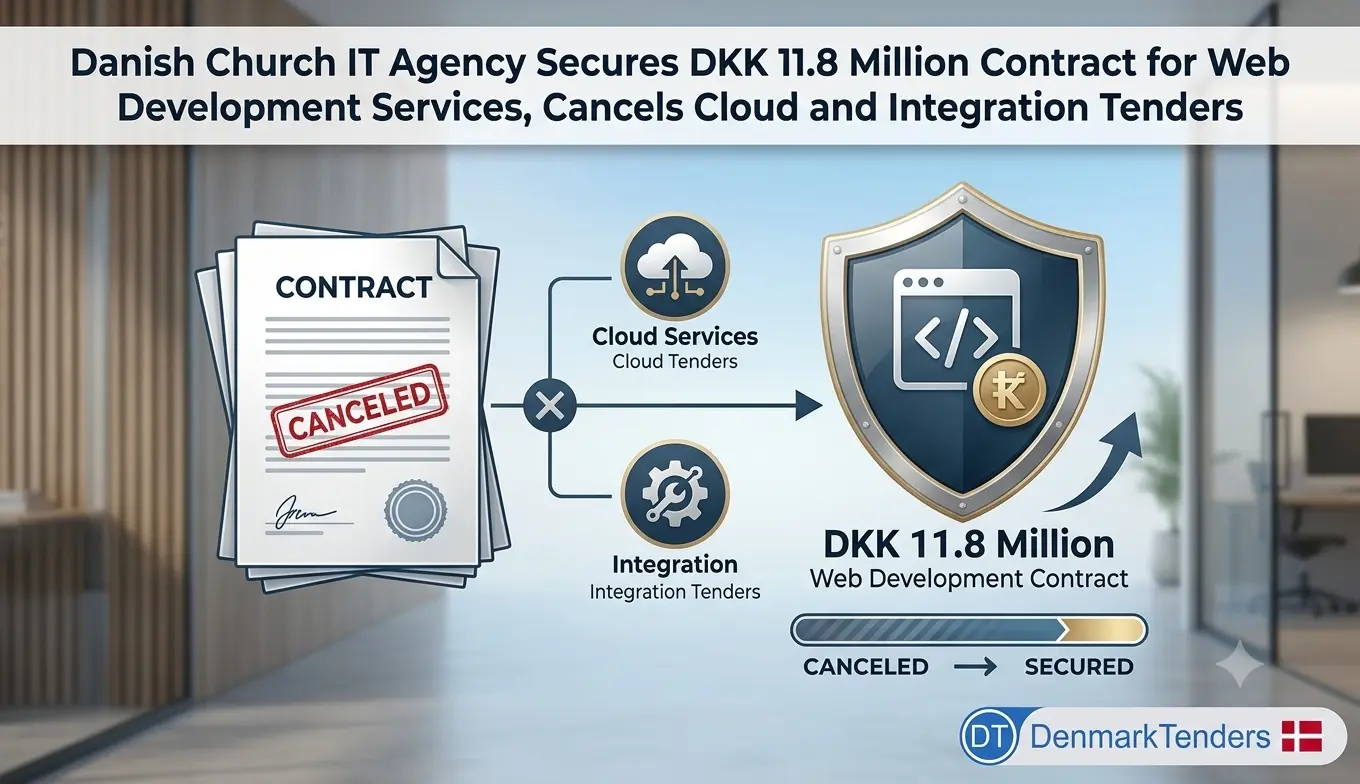
Danish Church IT Agency Secures DKK 11.8 Million Contract for Web Development Services, Cancels Cloud and Integration Tenders
13 Jul 2026
Folkekirkens It, the IT agency for the Danish National Church, has awarded a four-year IT consulting contract worth up to DKK 11.76 million (approximately €1.58 million) to 7Software ApS for web technologies development. The contract covers design, development, and further development of web-based solutions on the Microsoft technology stack. Two additional tenders for cloud platform and integration services were cancelled due to changing needs, illustrating how public sector IT procurement must adapt to evolving organizational requirements.IntroductionEvery modern organization depends on robust, secure IT systems. For the Danish National Church, with its nationwide network of parishes and administrative functions, that dependency is no different. Someone has to ensure that IT systems are developed, maintained, and integrated effectively. That responsibility now partially sits with 7Software ApS, after Folkekirkens It signed off on a new IT consulting contract worth up to DKK 11.76 million over four years.It is not a headline-grabbing infrastructure deal. But it is the kind of contract that keeps a major public organization's digital backbone running, and it says a great deal about how specialized IT procurement is evolving in the Danish public sector.Why This Contract MattersFolkekirkens It supports the IT needs of the Danish National Church, a public institution with a nationwide presence and a diverse user base. The organization manages a broad portfolio of IT systems primarily for administrative use. Maintaining and developing these systems requires specialized expertise in modern web technologies, cloud platforms, and system integration.This contract is a textbook example of how public organizations access specialist IT expertise that cannot be maintained in-house. By procuring external consulting services through a negotiated procedure, Folkekirkens It ensures access to high-level technical skills while maintaining flexibility to adapt to changing needs.For IT consultancies, the contract provides a stable, multi-year engagement with a guaranteed minimum monthly workload. For the church's administrative functions, it means ongoing system development and maintenance support from a dedicated specialist.Contract TimelinePrevious notice referenced: 2a888e22-2986-4926-bc68-da8022968a4c-01Winner chosen: 11 June 2026Contract concluded: 3 July 2026Contract duration: 4 years (initial term)Renewal options: Two additional 24-month extensions (maximum 8 years total)Contract OverviewFolkekirkens It ran a negotiated procedure with prior publication (competitive with negotiation) for this procurement. The procedure was divided into three sub-contracts (delkontrakter), each covering a specialist area:Sub-contract 1 – Web Technologies: Design, development, and further development of web-based solutionsSub-contract 2 – Cloud Platform (Microsoft Azure): Establishment, development, and use of cloud-based solutionsSub-contract 3 – Integration: Integration between internal and external systemsBidders could only apply for pre-qualification for one sub-contract. The evaluation criteria were weighted 60% quality (CV and competencies), 15% quality (collaboration), and 25% price.Results:Sub-contract 1 (Web Technologies): Awarded to 7Software ApSSub-contract 2 (Cloud Platform): Cancelled – no winner chosen due to change in needsSub-contract 3 (Integration): Cancelled – no winner chosen due to change in needsKey Contract Details Detail Information Contracting authority Folkekirkens It Winning bidder 7Software ApS Contract subject IT consulting – Web Technologies (CPV 72000000) Procedure type Negotiated with prior publication / competitive with negotiation Legal basis Directive 2014/24/EU Value of contract awarded DKK 11,760,000 Initial contract duration 4 years Renewal options Two additional 24-month extensions (max 8 years total) Bids received (Lot 1) 2 Bids received (Lot 2) 3 Bids received (Lot 3) 3 SME participation All bidders were SMEs EU funding No Covered by GPA Yes Contract concluded 3 July 2026 Award notice published 13 July 2026 (OJ S 132/2026) Project ScopeThe contract covers IT consulting services for Folkekirkens It's web-based solutions, supporting the ongoing operation, maintenance, and further development of a broad portfolio of IT systems primarily for administrative use.Technical Requirements:Full-stack development within the Microsoft technology stackWeb-based solutions using JavaScript frameworks (e.g., Vue.js and/or Blazor)Backend development in .NET (C#)Database technologies such as MS SQL and/or MongoDBMicrosoft Azure as cloud platform (PaaS)GIT for version controlCI/CD processes, including Azure DevOpsWork Arrangements:Primary workplace: Folkekirkens It's office at Johannes Ewalds Vej 42A, 8230 AarhusHybrid work possible, but physical attendance required as neededLimited physical attendance may be required in CopenhagenWork performed on the client's IT equipmentClose collaboration with the client's own employees and other suppliersGuaranteed Minimum Workload:Average consumption of 75 hours per month (over a 12-month period)The supplier is guaranteed payment for this average consumption regardless of monthly variationsExpected total average consumption: approximately 100 hours per monthAbout the Contracting AuthorityFolkekirkens It is the IT agency for the Danish National Church (Folkekirken). It is a public undertaking controlled by a central government authority, tasked with providing IT services to support the church's administrative functions across Denmark.The organization manages a wide portfolio of IT systems used by a large and diverse user group across the church organization. Its activities fall under the "Recreation, culture and religion" sector, reflecting the church's role in Danish society.Folkekirkens It operates from offices in both Aarhus (primary) and Copenhagen. The organization's contact email is kontakt@tohv.dk.About the Winning Company7Software ApS is a micro, small, or medium enterprise (SME) based in Silkeborg, Denmark (registration number 46185587). The company specializes in software development and IT consulting services.7Software ApS submitted the winning tender for Sub-contract 1 (Web Technologies). The company is led by Kim Kokholm, who serves as the contact point. The company is classified as an SME, consistent with all bidders across all lots.For this contract, the company will provide full-stack web development services on the Microsoft technology stack, working closely with Folkekirkens It's internal team and other suppliers. Subcontracting arrangements are not yet known.Procurement AnalysisProcedure: A negotiated procedure with prior publication was used, standard practice for complex technical service contracts where specifications and approaches require iterative discussion rather than a single fixed bid. The procedure included three phases:Pre-qualification phase (selecting suitable companies)Initial tender phaseNegotiation phase with subsequent submission of final tenderCompetition:Lot 1 (Web Technologies): 2 tenders receivedLot 2 (Cloud Platform): 3 tenders receivedLot 3 (Integration): 3 tenders receivedAll tenders were submitted electronically, and all came from SMEs. No tenders were received from outside Denmark (other EEA countries or non-EEA countries).Evaluation criteria: Quality was weighted substantially higher than price:CV and Competencies: 60%Collaboration: 15%Price: 25%The strong emphasis on CV and competencies (60%) reflects the specialist nature of the work, where individual consultant expertise is critical. The collaboration criterion (15%) reflects the requirement for close partnership with the client's internal team and other suppliers.Cancellations: Lots 2 and 3 were cancelled due to "a change in needs." This indicates that the client's organizational requirements evolved during the procurement process, leading to a decision not to proceed with those contracts. This is not unusual in dynamic IT environments where priorities can shift.GPA status: The contract falls under the WTO's Government Procurement Agreement, though all bidders were Danish SMEs.SME participation: All bidders across all lots were SMEs, indicating that the tender structure was accessible to smaller consultancies.Additional Procurement FactsThe contract references a previous notice (2a888e22-2986-4926-bc68-da8022968a4c-01), which was the initial call for competition.No framework agreement or dynamic purchasing system was used.The procurement is not financed with EU funds.The contract includes a guaranteed minimum workload of 75 hours per month (averaged over 12 months).The primary workplace is Aarhus, with limited attendance possible in Copenhagen.Review of procurement decisions falls to the Klagenævnet for udbud (Danish Complaints Board for Procurement).Review deadlines range from 20 to 45 calendar days depending on the type of complaint.Guaranteed Minimum Workload:A distinctive feature of this contract is the guaranteed minimum workload. The client guarantees an average consumption of 75 hours per month over a 12-month period. This provides revenue certainty for the supplier, even if actual monthly consumption varies. The expected total average consumption is approximately 100 hours per month.Market & Industry PerspectiveThe Danish public sector IT consulting market is mature and competitive, with a strong presence of SMEs and specialized consultancies. This procurement reflects several trends:Specialized procurement: By dividing the contract into three specialist areas, the client ensures access to deep expertise in each domain. This is increasingly common in complex IT procurements where no single supplier has all required skills.Quality over price: The 60% weighting on CV and competencies signals that client values individual expertise and track record over cost savings. For consultancies, this means investing in talent and demonstrating proven experience is critical.Flexibility: The cancellation of Lots 2 and 3 due to changing needs reflects the reality of IT procurement: organizational requirements evolve, and procurement processes must accommodate that flexibility.Regional focus: All bidders were Danish SMEs, suggesting that language, proximity, and cultural fit are significant factors in this market.Economic SignificanceAt DKK 11.76 million over the initial four-year term, this contract represents a significant commitment to IT development for the Danish National Church's administrative functions. With potential extensions (two additional 24-month periods), the total value could reach approximately DKK 35 million over the maximum eight-year term.The guaranteed minimum workload (75 hours per month) provides revenue certainty for 7Software ApS, reducing the business risk typically associated with project-based consulting engagements. For Folkekirkens It, the contract ensures access to specialized web development expertise on an ongoing basis.Future Procurement OpportunitiesThe cancellation of Lots 2 and 3 suggests that Folkekirkens It may re-tender these services at a later date, potentially with revised requirements. This represents a future pipeline opportunity for consultancies specializing in Microsoft Azure cloud services and system integration.Additionally, the contract includes two 24-month extension options for Lot 1, meaning 7Software ApS could continue delivering services through approximately 2034 if the client exercises both options. This provides long-term revenue certainty for the winning supplier.Recommended monitoring:Re-tendering of Lots 2 and 3 (Cloud Platform and Integration)Other Danish public sector IT consulting procurementsExtension decisions for Lot 1Opportunities for SuppliersIT consultancies active in the Danish public sector should note that specialized technical contracts of this kind recur across government agencies. Key success factors include:Deep technical expertise in specific domains (e.g., Microsoft stack, web technologies, cloud platforms)Proven track record with similar organizationsStrong CVs demonstrating relevant experienceAbility to work in close collaboration with client teamsPhysical presence in the client's region (Aarhus area)SME-friendly procurement structures that allow smaller consultancies to competeThe high weighting on CV and competencies (60%) suggests that suppliers should invest in talent development and ensure their key personnel have strong, relevant experience that can be clearly demonstrated in tender responses.What Businesses Should WatchRe-tendering of cancelled lots: Folkekirkens It may re-tender Lots 2 and 3 with revised requirements.Extension decisions: Whether the client exercises the two 24-month extension options will indicate satisfaction with 7Software ApS's performance.Other Danish public sector IT tenders: Similar contracts are likely across other government agencies.SME opportunities: The all-SME bidding pattern suggests these tenders are accessible to smaller consultancies.Denmarktenders.com Procurement IntelligenceThis procurement is a useful case study in how Danish public organizations access specialist IT expertise. The negotiated procedure with pre-qualification ensures that only qualified suppliers participate, while the heavy weighting on CV and competencies (60%) prioritizes individual expertise over price.The cancellation of two of the three lots due to "change in needs" is a notable signal. It reflects the reality that IT requirements evolve, particularly during procurement processes that can take months. Rather than proceeding with contracts that no longer fit organizational needs, the client chose to cancel and re-evaluate. This is a mature procurement approach that prioritizes fit-for-purpose solutions over simply completing the process.The guaranteed minimum workload (75 hours per month) is an interesting feature that provides revenue certainty for the supplier while ensuring the client has access to capacity when needed. This structure reduces the risk for both parties.For suppliers, the lesson is that public sector IT consulting procurement in Denmark prioritizes technical expertise and proven experience over price. Companies that invest in talent and can demonstrate relevant experience are best positioned. The all-SME bidding pattern also suggests that smaller consultancies are competitive in this market.Supplier TakeawaysDanish public sector IT consulting tenders prioritize quality and expertise over price (60% CV weighting).SMEs are highly competitive in this market; all bidders were SMEs.Physical presence in the client's region (Aarhus) is important for collaboration.Guaranteed minimum workloads provide revenue certainty for winning suppliers.Contracts with extension options offer multi-year revenue potential.Cancellations due to changing needs may create re-tendering opportunities.Key TakeawaysFolkekirkens It awarded a web technologies IT consulting contract worth up to DKK 11.76 million to 7Software ApS.Two additional tenders for cloud platform and integration services were cancelled due to changing needs.The contract runs for four years initially, with two optional 24-month extensions (up to eight years total).The evaluation criteria were weighted 60% CV/competencies, 15% collaboration, and 25% price.All bidders across all lots were Danish SMEs, with no international participation.The contract includes a guaranteed minimum workload of 75 hours per month.ConclusionThis is not a contract that will make national headlines, but it reflects something structurally important about how Danish public organizations access specialist IT expertise. By procuring web development services through a negotiated procedure focused on competencies, Folkekirkens It ensures it has access to the technical skills needed to maintain and develop its administrative systems. 7Software ApS now carries that responsibility through the initial term, with potential extensions through 2034.The cancellation of the cloud and integration tenders also demonstrates an important principle: procurement must serve organizational needs, not the other way around. When requirements change, the responsible course is to cancel and re-evaluate.Frequently Asked QuestionsQ: What is Folkekirkens It?Folkekirkens It is the IT agency for the Danish National Church, a public undertaking that provides IT services to support the church's administrative functions.Q: What does this contract cover?The contract covers IT consulting services for web technologies, including design, development, and further development of web-based solutions on the Microsoft technology stack.Q: Why were two tenders cancelled?Lots 2 (Cloud Platform) and 3 (Integration) were cancelled due to a change in needs, reflecting evolving organizational requirements.Q: What is the contract value?The contract is valued at DKK 11,760,000 for the initial four-year term.Q :How long does the contract last?The initial term is four years, with two optional 24-month extensions (up to eight years total).Q: How was the winner selected?Evaluation criteria were weighted 60% CV and competencies, 15% collaboration, and 25% price.Q: Is this contract funded by the EU?No. The procurement is fully financed by Folkekirkens It, not EU funds.Q : Are there opportunities for international bidders?Yes, the contract is covered by the WTO's Government Procurement Agreement. However, all bidders were Danish SMEs, suggesting local presence and relationships are important.Source: EU Official Journal, OJ S 132/2026, published 13 July 2026.
View Details