Latest Info on Denmark gov spend, Public Purchasing, Govt budget & Public spending
- Home >
- Public Procurement
Public Procurement in Denmark
Public procurement in Denmark represents a mature, transparent, and highly regulated market that plays a central role in public service delivery, infrastructure development, and government operations. With a long-standing tradition of administrative efficiency and rule-based governance, Denmark’s procurement environment offers predictability and confidence for both domestic suppliers and international bidders.
Government purchasing in Denmark spans goods, works, and services across central government, regions, and municipalities. Public procurement is closely aligned with European Union procurement principles while being administered through strong national institutions. Competitive tendering, digital procurement tools, and clear complaint mechanisms are key features of the Danish system.
For international companies, public procurement in Denmark offers access to a high-income economy with stable demand, clear legal safeguards, and advanced sustainability practices. Understanding the governance structure, legal framework, and procedural requirements is essential for successful participation in government tenders in Denmark.
Country & Economic Overview
| Country | Denmark |
| Region | Europe and Central Asia |
| Population | 5.96 million (2024) |
| Income Level | High-income economy |
| Currency | Danish Krone (DKK) |
| Exchange Environment | Stable, with long-standing peg to the euro |
| GDP | USD 430 billion (2024) |
| GNI | USD 425 billion (2024) |
| GNI per Capita | USD 71,500 (2024) |
Denmark’s strong macroeconomic fundamentals, combined with institutional stability, support a predictable procurement market with consistent public spending capacity.
Public Procurement Governance Framework
The public procurement system in Denmark is overseen by a centralized national authority responsible for regulation, guidance, and supervision of procurement practices across public entities.
- Public Procurement Agency (PPA): Danish Competition and Consumer Authority
- Role: Regulatory oversight, legal interpretation, competition safeguards, and procurement guidance
- Central Purchasing Body (CPB): Centralized purchasing functions are recognized within the national framework
In addition to the central authority, line ministries, regions, and municipalities act as contracting authorities and conduct procurement in accordance with national legislation.
Legal & Regulatory Framework
Public procurement in Denmark is governed by a comprehensive Public Procurement Act that aligns national rules with European Union procurement directives. The legislation establishes clear procedural requirements and enforceable bidder rights.
- Legally binding competitive procurement procedures
- Explicit provisions for transparency and equal treatment
- Mandatory publication and disclosure obligations
- Clear appeal and complaint mechanisms
The law embeds core procurement principles such as value for money, competition, proportionality, and non-discrimination. Award decisions may be based on the Most Economically Advantageous Tender (MEAT), incorporating price and quality considerations.
Procurement Procedures & Thresholds
Danish contracting authorities apply structured procedures depending on contract value and type. Competitive tendering remains the default method for most public contracts.
| Contract Category | Key Thresholds |
| Works | EUR 5,376,047 |
| Services (Central Government) | EUR 139,847 |
| Services (Sub-central Authorities) | EUR 214,763 |
Standstill periods apply to goods, works, and services contracts, allowing bidders to challenge award decisions before contract signature. Complaint resolution timelines and disclosure obligations are explicitly defined in law.
E-Procurement System Overview
Denmark has long adopted electronic procurement as a core component of its public purchasing system.
| System Name | Ethics |
| Launch Year | 2003 |
| Ownership Model | National platform |
| Primary Purpose | Publication and management of public tenders |
The eProcurement system in Denmark supports electronic tendering and enhances transparency by enabling online access to procurement notices and documentation.
Procurement Market Characteristics
Denmark’s public procurement market covers a broad range of sectors, including infrastructure, energy, transport, information technology, healthcare, and professional services.
- Annual number of tenders: approximately 2,600
- High use of competitive and open procedures
- Strong participation of domestic suppliers alongside international bidders
- Extensive application of MEAT evaluation methodology
Framework agreements and centralized purchasing arrangements are widely used to achieve efficiency and cost savings.
Transparency, Complaints & Oversight
Transparency is a defining characteristic of public procurement in Denmark. Contract award information, procurement statistics, and annual reports are regularly published.
- Formal complaint review body with statutory authority
- Defined resolution period for procurement disputes
- Public access to procurement performance data
The complaint system allows suppliers to challenge procurement decisions in a structured and legally secure manner.
Sustainability & Green Public Procurement
Denmark is internationally recognized for its advanced approach to green public procurement. Environmental considerations are actively integrated into public purchasing decisions.
- National green procurement strategy and roadmap
- Sector-specific application in energy, transport, ICT, and industry
- Mandatory green requirements for selected product categories
Public buyers are encouraged to apply life-cycle costing and environmentally responsible disposal practices to reduce environmental impact.
Social & Ethical Procurement Considerations
Danish procurement law incorporates social and ethical safeguards designed to ensure responsible sourcing and fair competition.
- Mandatory exclusion of suppliers involved in child labor or human trafficking
- Reserved contracts available for certain social and economic enterprises
- Alignment with international labor standards
While gender-based award preferences are not mandated, ethical compliance is a core requirement for supplier eligibility.
Key Challenges & Practical Insights for Bidders
Despite its strengths, bidders entering the Danish procurement market should be aware of practical considerations:
- High documentation and compliance standards
- Strong competition from experienced local suppliers
- Strict adherence to procedural deadlines
Successful bidders typically invest in understanding local procurement practices, prepare high-quality technical submissions, and demonstrate compliance with sustainability and ethical standards.
Public Procurement in Denmark offers a transparent, rules-based, and opportunity-rich environment for companies prepared to meet its high professional and regulatory expectations.
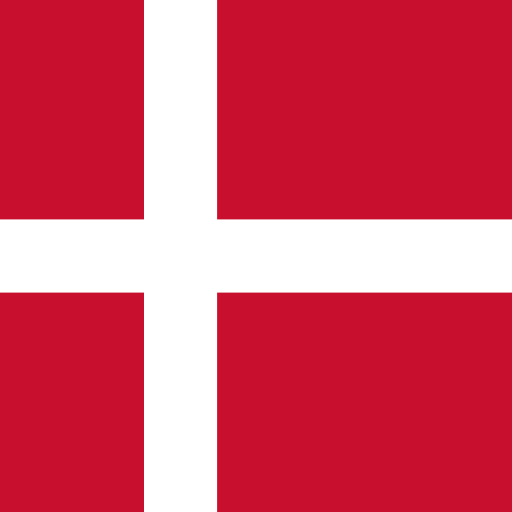
Flag of Denmark

Emblem of Denmark
Capital
Copenhagen
ISO 3166 Code
DK
Population
5,655,750
Area, Sq KM
43,094
Currency
Danish krone[a]
GDP, Billion USD
3,35,878
Language
Danish
GDP Growth Rate, %
1.5
Inflation, Avg CP, %
-0.75
Interest Rates, %
-
Unemployement Rate, %
6.8
Exchange Rate, 1 USD Equals
6.57
International dial code
45
Time ZONE
GMT+01:00
Internet TLD
.dk
Get FREE SAMPLE TENDERS from Denmark in your email inbox.
Copyright © 2014-2026 DenmarkTenders.com. All Rights Reserved.