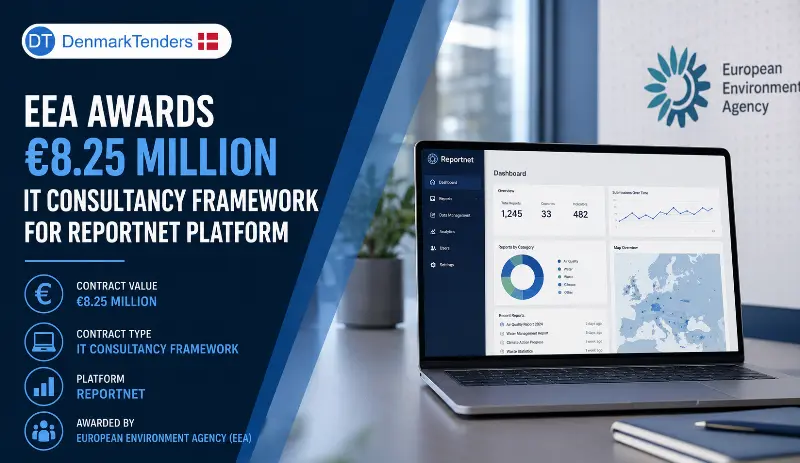
EEA Awards €8.25 Million IT Consultancy Framework for Reportnet Platform
10 Aug 2026
The European Environment Agency (EEA) has awarded an €8.25 million framework contract for IT consultancy services to support Reportnet, its e-reporting platform for environmental data. The framework, awarded to three consortia led by European Dynamics, NTT DATA, and Thaleria, covers Java software development, DevOps, and IT support services over an initial 24-month period with one renewal option. Introduction Environmental data reporting is essential for monitoring and protecting Europe's environment. The European Environment Agency's Reportnet platform serves as the backbone for collecting, processing, and sharing environmental data from European countries. To maintain and extend this critical infrastructure, the EEA has established a framework contract for IT consultancy services valued at up to €8.25 million. The framework, awarded to three consortia, covers Java software development, DevOps in a hybrid cloud environment, and multi-tier IT support services. This contract ensures that Reportnet continues to evolve as a modern, secure, and efficient platform for environmental data reporting across Europe. Why This Contract Matters Reportnet is a critical platform for environmental data reporting, supporting the EEA's mission to provide timely, reliable, and policy-relevant environmental information. Robust IT support is essential for maintaining and improving this platform. This contract matters because it: Supports environmental reporting: Maintains and extends Reportnet, the EEA's e-reporting platform Covers essential IT services: Java development, DevOps, and multi-tier support Significant value: €8.25 million framework Quality-focused: Quality weighting of 70%, price 30% Competitive process: 23 bids received EU-funded: Project is fully or partially financed with EU funds Cascade model: Three suppliers ranked in cascade Contract Timeline Contract award notice published: 10 August 2026 (OJ S 152/2026) Previous notice referenced: 766148-2025 Winner chosen: 3 July 2026 Contract concluded: 20-28 July 2026 Coverage start date: Not specified Coverage end date: Up to 48 months (24-month initial + 1 renewal of 24 months) Contract Overview The European Environment Agency conducted an open procedure for this procurement. The framework is a cascade model with three ranked suppliers for IT consultancy services supporting Reportnet. Key features include: Cascade framework: Three suppliers ranked 1, 2, and 3 Duration: 24 months initial + 1 x 24-month renewal (max 48 months) Value: €8,250,000 (estimated) Evaluation: Quality (70%) and Price (30%) Services: Java software development, DevOps, and IT support EU funding: Fully or partially financed with EU funds Key Contract Details Detail Information Contracting authority European Environment Agency (EEA) Winning consortia European Dynamics (Rank 1), NTT DATA (Rank 2), Thaleria (Rank 3) Contract subject IT consultancy services (CPV 72000000) Procedure type Open procedure Legal basis Regulation (EU, Euratom) 2024/2509 Estimated value (EUR) €8,250,000.00 Contract duration 24 months + 1 x 24-month renewal (max 48 months) Bids received 23 EU funding Fully or partially financed with EU funds Covered by GPA No Evaluation criteria Quality (70%), Price (30%) Framework type Framework agreement, without reopening of competition Project Scope The framework covers IT consultancy services to support Reportnet, the EEA's e-reporting platform for environmental data. The scope includes: Service Areas Java software development: Web and frontend applications Backend applications (microservices, containerised applications) DevOps: Deployment of applications in hybrid cloud environment Continuous Delivery and Continuous Integration (CD/CI) pipelines Hypervisor-based virtualisation and clustering Container technologies and orchestrator platforms (Kubernetes) IT support services: Tier 1 (first level) support Tier 2 (second level) support Tier 3 (third level) support for Reportnet platforms Framework Structure Cascade model: Three suppliers ranked by evaluation score Rank 1: European Dynamics (primary supplier) Rank 2: NTT DATA (secondary supplier) Rank 3: Thaleria (tertiary supplier) About the Contracting Authority European Environment Agency (EEA) is an agency of the European Union based in Copenhagen, Denmark. The EEA's mission is to provide sound, independent information on Europe's environment. Reportnet is the EEA's e-reporting platform, which collects and processes environmental data from European countries to support policy-making and public awareness. About the Winning Consortia Rank 1: ED LUXEMBOURG / European Dynamics SA. European Dynamics is a leading European IT company specialising in public sector and EU institution projects. With a strong track record in delivering complex IT systems for EU agencies, European Dynamics brings extensive experience in Java development, DevOps, and cloud infrastructure. The company is ranked 1st in the cascade framework, making it the primary supplier for the EEA. Rank 2: NTT DATA BELGIQUE / DUKAT ORB S.L. NTT DATA is a global IT services provider with a strong presence in the European public sector. The consortium includes DUKAT ORB S.L., a Spanish IT company. NTT DATA's extensive experience in IT consultancy, cloud services, and enterprise solutions positions it well to support Reportnet. The consortium has declared subcontracting valued at €4,207,500 (51% of the estimated value). Rank 3: THALERIA / UNISYSTEMS LUXEMBOURG SARL Thaleria is a Belgian IT company specialising in digital transformation and IT services for public sector clients. The consortium includes UNISYSTEMS Luxembourg, a Luxembourg-based IT company. Thaleria brings expertise in Java development, DevOps, and cloud technologies. The consortium has declared subcontracting valued at €2,062,500 (25% of the estimated value). Procurement Analysis Procedure: An open procedure was used, allowing any interested economic operator to submit a tender. Competition: Twenty-three bids were received, representing very strong competition in the EU IT consultancy market. Evaluation criteria: Quality (70%) and Price (30%). The heavy weighting on quality reflects the EEA's focus on technical expertise, methodology, and service delivery. Cascade model: Three suppliers ranked in cascade ensures continuity of service and risk mitigation. EU funding: The project is fully or partially financed with EU funds. Subcontracting: Two of the three winners declared subcontracting (NTT DATA: 51%, Thaleria: 25%). European Dynamics declared no subcontracting. International participation: 22 of 23 bids came from outside Denmark (the buyer's country), demonstrating strong international competition. Additional Procurement Facts The procurement is covered by the European Union's Financial Regulation (Regulation (EU, Euratom) 2024/2509). The procurement is not covered by the WTO's Government Procurement Agreement (GPA). The project is fully or partially financed with EU funds. No dynamic purchasing system was used. Framework agreements without reopening of competition were used. Twenty-three bids were received, all submitted electronically. Only 2 of 23 bids were from SMEs. 22 bids were from other EEA countries (outside Denmark). Disputes or review requests fall to the Court of Justice of the European Union. Market & Industry Perspective The EU IT consultancy market is highly competitive, with major European and global players competing for public sector contracts. This procurement attracted 23 bids, demonstrating strong market interest in EU agency contracts. Key trends in this market include: Quality focus: EU agencies increasingly prioritise quality and expertise over price Cloud adoption: Hybrid cloud and containerisation are key priorities DevOps: Continuous Delivery/Integration is essential for modern IT International competition: Suppliers from across the EEA compete for EU contracts Cascade models: Multi-supplier frameworks provide flexibility and risk mitigation Economic Significance At €8.25 million, this framework represents a significant investment in the EEA's digital infrastructure. The contract supports: Environmental reporting: Maintaining and extending Reportnet, a critical platform for environmental data EU policy support: Enabling evidence-based environmental policy-making IT employment: Supporting IT jobs across the European Economic Area Digital transformation: Modernising the EEA's IT infrastructure Future Procurement Opportunities With the framework now in place, future opportunities include: Contract renewal: One renewal option of 24 months Additional services: The framework includes options for similar services up to 50% of the initial contract Other EU agencies: Similar IT frameworks are conducted by other EU institutions and agencies Evolving technologies: Emerging technologies may create new opportunities Opportunities for Suppliers While this framework is awarded, future opportunities exist for IT consultancy firms: Subcontracting: Suppliers may find subcontracting opportunities with the winning consortia Other EU agencies: Similar frameworks are conducted by other EU institutions Renewal: The framework may be renewed after 24 months Options: Similar services may be procured up to 50% of the initial contract What Businesses Should Watch Other EU agency IT procurement notices EEA's future procurement notices Emerging technologies in cloud, DevOps, and Java development Changes to EU procurement regulations EU funding programmes for digital transformation DenmarkTender Procurement Intelligence This IT consultancy framework is a significant procurement for the EEA. Several features stand out: Quality focus: The 70% quality weighting reflects the EEA's prioritisation of technical expertise, methodology, and service quality Cascade model: Three suppliers ranked in cascade provides continuity and risk mitigation Competitive process: 23 bids demonstrate strong market interest Subcontracting: Two of three winners declared subcontracting, indicating the importance of consortium partnerships The selection of European Dynamics as the primary supplier reflects the company's strong track record with EU institutions. NTT DATA and Thaleria as secondary and tertiary suppliers provide depth and resilience. For suppliers, this procurement highlights the importance of: Quality: Demonstrating technical expertise and methodology (70% of evaluation) Competitive pricing: Price accounts for 30% of evaluation EU institution experience: Experience with EU agencies is a significant advantage Consortium partnerships: Strong consortium bids can be more competitive Subcontracting strategy: Strategic subcontracting can enhance bids Supplier Takeaways Demonstrate technical expertise and methodology—quality accounts for 70% of evaluation Offer competitive pricing—price accounts for 30% Develop experience with EU institutions and agencies Consider consortium partnerships to strengthen bids Develop expertise in Java, DevOps, Kubernetes, and cloud technologies Monitor other EU agency procurement notices for similar opportunities Key Takeaways EEA awarded an €8.25 million IT consultancy framework for Reportnet Winners: European Dynamics (Rank 1), NTT DATA (Rank 2), Thaleria (Rank 3) Services: Java development, DevOps, and IT support Evaluation: Quality (70%), Price (30%) 23 bids received, 22 from outside Denmark Contract duration: 24 months + 1 renewal (max 48 months) EU-funded project Subcontracting declared by NTT DATA (51%) and Thaleria (25%) Conclusion This IT consultancy framework represents a significant investment in the European Environment Agency's digital infrastructure. By establishing a cascade framework with three suppliers, the EEA ensures that Reportnet—its critical e-reporting platform for environmental data—is supported by leading European IT companies. The selection of European Dynamics, NTT DATA, and Thaleria reflects the strong competition in the EU IT consultancy market, with 23 bids received. The 70% quality weighting demonstrates the EEA's focus on technical expertise, methodology, and service delivery. As the framework runs for up to 48 months, the EEA will benefit from robust IT support for its environmental data reporting platform, enabling the agency to continue providing sound, independent information on Europe's environment. Frequently Asked Questions Q: What is the European Environment Agency? Ans: An EU agency based in Copenhagen, Denmark, providing independent information on Europe's environment. Q: What is Reportnet? Ans: The EEA's e-reporting platform for collecting and processing environmental data from European countries. Q: What is the value of the framework? Ans: €8,250,000 (estimated). Q: Who are the winners? Ans: European Dynamics (Rank 1), NTT DATA (Rank 2), Thaleria (Rank 3). Q: What services are covered? Ans: Java software development, DevOps (CD/CI, Kubernetes, hybrid cloud), and Tier 1, 2, and 3 IT support. Q: What were the evaluation criteria? Ans: Quality (70%) and Price (30%). Q: How many bids were received? Ans: 23 bids were received. Q: Is this contract funded by the EU? Ans: Yes, the project is fully or partially financed with EU funds. Source: EU Official Journal, Contract Award Notice 551573-2026, OJ S 152/2026, published 10 August 2026. body { font-family: sans-serif; margin: 20px; } table { border-collapse: collapse; width: 100%; margin: 15px 0; } th, td { border: 1px solid #ddd; padding: 8px; text-align: left; vertical-align: top; } th { background-color: #f2f2f2; } ul { padding-left: 20px; } h2 { margin-top: 30px; } h3 { margin-top: 20px; }
View Details
Danish Defence Cancels €5.4 Million IP Phone and VTC Framework
07 Aug 2026
The Danish Defence Acquisition and Logistics Organisation (FMI) has cancelled a €5.4 million framework agreement for no-radio IP phones and VTC equipment after identifying non-market-conforming elements in the tender documents. The procurement, which aimed to establish three parallel framework agreements with a total estimated value of DKK 50 million, received zero bids and will be re-tendered. Introduction Reliable and secure communication systems are essential for defence organisations. The Danish Defence Acquisition and Logistics Organisation (Forsvarsministeriets Materiel- og Indkøbsstyrelse – FMI) sought to establish a framework agreement for no-radio IP phones and VTC (Video Teleconferencing) equipment to support communication and video conferencing functions across the Danish Ministry of Defence. However, the procurement was cancelled after FMI identified elements in the tender documents that were not market-conforming and could not be adjusted within the ongoing procedure. The tender received zero bids, and FMI plans to re-tender the framework as soon as possible. This outcome highlights the importance of market alignment in public procurement, particularly for specialised defence and telecommunications equipment. Why This Contract Matters Reliable communication and video conferencing capabilities are critical for defence operations, internal collaboration, and supplier dialogue. The framework would have provided the Danish Ministry of Defence with access to no-radio IP phones and VTC equipment. This contract mattered because it: Supported defence communications: Provided secure and stable communication and video conferencing functions Covered multiple entities: All units under the Danish Ministry of Defence could use the framework Significant value: Estimated value of DKK 40-50 million (approximately €5.4-6.7 million) Three suppliers: Would have established three parallel framework agreements Demonstrates market challenges: Zero bids indicate misalignment between requirements and market capabilities Contract Timeline Contract award notice published: 7 August 2026 (OJ S 151/2026) Previous notice referenced: e9d1767e-e6b8-4cfe-95d5-3cf0eac785cb-01 Outcome: Cancelled - non-market-conforming requirements, zero bids Planned re-tender: As soon as possible Contract Overview FMI conducted an open procedure for this procurement. The framework was intended to be awarded to three suppliers for the supply of no-radio IP phones and VTC equipment. Key features included: Three parallel framework agreements: Identical terms and obligations for all three suppliers Duration: 4 years Estimated value: DKK 40,000,000 (up to DKK 50,000,000 maximum) Evaluation: Price only (100%) Ordering: Cascade model for orders under DKK 200,000; mini-competition for orders over DKK 200,000 Compatibility: Equipment must be compatible with the buyer's existing IT environment Delivery: Maximum 4 weeks from order Coverage: All units under the Danish Ministry of Defence Key Contract Details Detail Information Contracting authority Forsvarsministeriets Materiel- og Indkøbsstyrelse (FMI) Contract subject No-radio IP phones and VTC equipment (CPV 32000000) Procedure type Open procedure Legal basis EU Directive 2014/24/EU Estimated value (DKK) DKK 40,000,000.00 Maximum value (DKK) DKK 50,000,000.00 Contract duration 4 Years Bids received 0 EU funding None Covered by GPA Yes Outcome Cancelled - non-market-conforming requirements Evaluation criteria Price only (100%) Number of suppliers 3 (planned) Project Scope The framework was intended to cover the supply of no-radio IP phones and VTC equipment for the Danish Ministry of Defence. The scope included: Equipment Categories No-radio IP phones: Internet Protocol phones without radio functionality VTC equipment: Video Teleconferencing equipment for meetings and collaboration Compatibility: Equipment must be compatible with the buyer's existing IT environment Coverage Contracting party: FMI Authorised users: All units under the Danish Ministry of Defence, including all divisions of the Danish Defence under the Chief of Defence Ordering Procedure Orders under DKK 200,000: Cascade model to the supplier with the most economically advantageous offer Orders of DKK 200,000 or more: Mini-competition among the three framework suppliers Delivery: Maximum 4 weeks from order (or as per supplier's bid for mini-competitions) About the Contracting Authority Forsvarsministeriets Materiel- og Indkøbsstyrelse (FMI) is the Danish Defence Acquisition and Logistics Organisation, a central government authority under the Danish Ministry of Defence. FMI is responsible for the procurement, acquisition, and logistics of equipment and services for the Danish Defence. The organisation ensures that the Danish Armed Forces have the necessary equipment and supplies to carry out their missions. Reasons for Cancellation FMI cancelled the procurement for the following reasons: Non-market-conforming requirements: FMI identified elements in the tender documents that were not aligned with market capabilities Impossible to adjust: The non-market-conforming elements could not be adjusted within the ongoing procurement procedure Zero bids: No tenders were received, indicating that potential suppliers could not meet the requirements Re-tender planned: FMI intends to conduct a new tender as soon as possible, based substantially on the current tender documents Additional Procurement Facts The contract is covered by the WTO's Government Procurement Agreement (GPA). No EU funds were used for this procurement. The procurement was not accelerated. No dynamic purchasing system was used. No framework agreement was awarded. Zero bids were received. The tender was cancelled due to non-market-conforming requirements. A re-tender is planned as soon as possible. Disputes or review requests fall to Klagenævnet for Udbud (Danish Complaints Board for Procurement). Market & Industry Perspective The market for IP phones and VTC equipment in the defence sector is characterised by specific requirements for security, compatibility, and reliability. Defence organisations often have unique technical and security requirements that must be balanced with market availability. Key trends in this market include: Security requirements: Defence communications equipment must meet high security standards Compatibility: Equipment must integrate with existing defence IT infrastructure Specialised suppliers: The market for defence-grade communication equipment is specialised Price focus: Defence procurement often emphasises cost-effectiveness The cancellation of this tender highlights the challenges of aligning defence procurement requirements with market capabilities. The zero-bid outcome suggests that the requirements, as specified, were not achievable by potential suppliers. FMI's decision to re-tender with substantially the same documentation suggests that minor adjustments may be sufficient to make the tender market-conforming. Economic Significance At an estimated value of DKK 40-50 million (approximately €5.4-6.7 million), this framework would have been a significant procurement for suppliers of IP phones and VTC equipment. The cancellation means that FMI will need to seek alternative procurement routes or revise its requirements to attract bidders. For potential suppliers, the cancellation represents a missed opportunity, though the planned re-tender offers a second chance. The zero-bid outcome suggests that the initial requirements may have been too restrictive, and the re-tender may offer improved terms. Future Procurement Opportunities With the procurement now cancelled, future opportunities include: Re-tender: FMI plans to re-tender the framework as soon as possible Adjusted requirements: The re-tender may feature revised, more market-conforming requirements Other defence procurements: FMI conducts numerous procurements for defence equipment Similar frameworks: Other defence organisations may conduct similar tenders Opportunities for Suppliers While this procurement is cancelled, future opportunities exist for suppliers: Re-tender: Prepare for the re-tender, which is expected to be based substantially on the current documents Engage with FMI: Provide feedback on the requirements to help make the re-tender more market-conforming Compatibility: Ensure equipment can demonstrate compatibility with the buyer's IT environment Competitive pricing: Price-only evaluation means competitive pricing is essential Other defence opportunities: Monitor FMI's procurement portal for other opportunities What Businesses Should Watch Re-tendering of this framework by FMI Revised requirements in the re-tender Other FMI procurement notices for defence communication equipment Changes to Danish defence procurement regulations Emerging technologies in IP telephony and VTC DenmarkTender Procurement Intelligence This cancelled procurement is a valuable case study in defence procurement. Several lessons can be drawn: Market alignment: Defence procurement must balance specific requirements with market capabilities Zero-bid outcomes: Zero bids are a clear signal that requirements are not market-conforming Re-tender planning: FMI's commitment to re-tender quickly demonstrates responsiveness to market feedback Price-only evaluation: Price-only evaluation may not be suitable for complex technical equipment The zero-bid outcome is a powerful signal to FMI that the procurement approach needs to be revised. For suppliers, the cancellation presents an opportunity to engage with FMI and influence the re-tender design. Supplier Takeaways Prepare for the re-tender—it is expected to be based substantially on the current documents Engage with FMI to provide feedback on market-conforming requirements Ensure equipment compatibility with the buyer's IT environment Offer competitive pricing—price-only evaluation means cost is the sole criterion Monitor FMI's procurement portal for the re-tender announcement Consider partnering with other suppliers to offer comprehensive solutions Key Takeaways FMI cancelled a DKK 40-50 million framework for no-radio IP phones and VTC equipment Cancellation reason: non-market-conforming requirements Zero bids received Planned 4-year framework with 3 suppliers Evaluation: Price only (100%) Ordering: Cascade model (< DKK 200,000) and mini-competition (≥ DKK 200,000) Re-tender planned as soon as possible All Danish Ministry of Defence units authorised to use the framework Conclusion The cancellation of this procurement represents a setback for FMI's plans to establish a framework for no-radio IP phones and VTC equipment. However, the zero-bid outcome provides valuable market feedback, indicating that the requirements were not aligned with what suppliers could offer. FMI's decision to re-tender the framework as soon as possible, based substantially on the current documents, suggests that the organisation is committed to securing the equipment it needs. Suppliers should prepare for the re-tender and engage with FMI to help ensure that the requirements are market-conforming. For the Danish Ministry of Defence, the eventual framework will provide essential communication and video conferencing capabilities, supporting internal collaboration, supplier dialogue, and defence operations. Frequently Asked Questions Q: What is FMI? Ans: Forsvarsministeriets Materiel- og Indkøbsstyrelse – the Danish Defence Acquisition and Logistics Organisation, responsible for procurement for the Danish Defence. Q: What was the value of the framework? Ans: Estimated DKK 40,000,000 (up to DKK 50,000,000 maximum), approximately €5.4-6.7 million. Q: Why was the procurement cancelled? Ans: Due to non-market-conforming requirements in the tender documents that could not be adjusted within the ongoing procedure. Q: How many bids were received? Ans: Zero. Q: What does "no-radio IP phones" mean? Ans: IP phones without radio functionality, for communication without radio transmission. Q: What is VTC equipment? Ans: Video Teleconferencing equipment for meetings and video collaboration. Q: Will the framework be re-tendered? Ans: Yes, FMI plans to re-tender as soon as possible. Q: Is this contract funded by the EU? Ans: No, the procurement is not financed with EU funds. Source: EU Official Journal, Contract Award Notice 549243-2026, OJ S 151/2026, published 7 August 2026. body { font-family: sans-serif; margin: 20px; } table { border-collapse: collapse; width: 100%; margin: 15px 0; } th, td { border: 1px solid #ddd; padding: 8px; text-align: left; vertical-align: top; } th { background-color: #f2f2f2; } ul { padding-left: 20px; } h2 { margin-top: 30px; } h3 { margin-top: 20px; }
View Details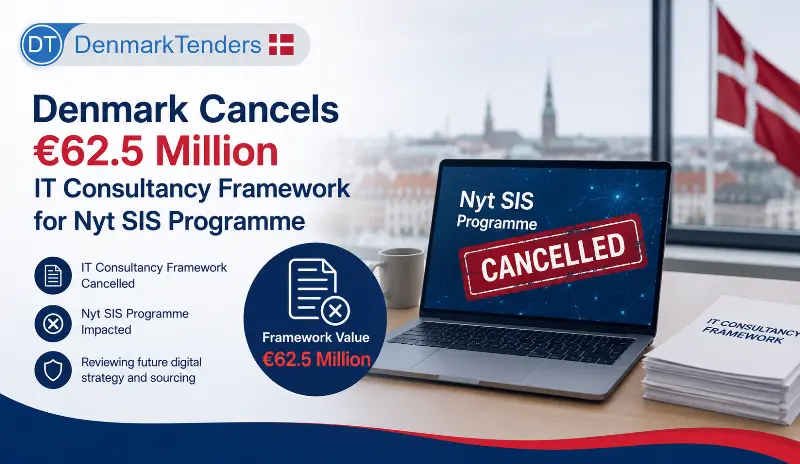
Denmark Cancels €62.5 Million IT Consultancy Framework for Nyt SIS Programme
06 Aug 2026
The Nyt SIS Programme, a collaboration of seven Danish universities, has cancelled a €62.5 million framework agreement for IT consultancy services due to a change in needs. The tender, which received eight bids, was divided into two lots covering business analysis, project management, data processing, and testing services for the implementation of a new student administration system. Introduction Modernising university student administration systems is a complex and resource-intensive undertaking. In Denmark, seven universities—DTU, KU, SDU, ITU, RUC, AAU, and CBS—have joined forces under the "Nyt SIS" (New Student Information System) Programme to replace the existing "STADS/DANS" system with a new, shared student administration platform. To support this ambitious programme, the universities sought to establish a framework agreement for external IT consultancy services valued at up to DKK 125 million (approximately €16.8 million). However, despite receiving eight bids, the procurement was cancelled due to a change in the programme's needs. This outcome highlights the challenges of large-scale IT transformation projects and the importance of aligning procurement with evolving programme requirements. Why This Contract Matters The Nyt SIS Programme represents a significant investment in the digital infrastructure of Danish universities. A new student administration system will impact thousands of students and staff across seven institutions. This contract matters because it: Supports major IT transformation: The framework would have provided essential consultancy resources for the Nyt SIS Programme Involves all Danish universities: Seven universities collaborated on the procurement Significant value: Framework valued at up to DKK 125 million (€16.8 million) Quality-focused evaluation: Quality criteria weighted 60% (sector insight 20%, competencies 40%) and price 40% Demonstrates market interest: Eight bids received despite cancellation Contract Timeline Contract award notice published: 6 August 2026 (OJ S 150/2026) Previous notice referenced: 1cdf3457-7bd5-486c-9a54-76a966b769df-01 Outcome: Cancelled - change in needs Bids received: 8 Contract Overview The Nyt SIS Programme, coordinated by DTU (Danmarks Tekniske Universitet), conducted an open procedure for this procurement. The framework was divided into two lots covering different IT consultancy service areas. Key features included: Two lots: Delaftale 1 (Business analysis, project management, data processing) and Delaftale 2 (Testing) Duration: 2 years with 2 x 12-month extensions (max 4 years) Total estimated value: DKK 62.5 million (up to DKK 125 million maximum) Evaluation: Quality (60%) and Price (40%) Quality criteria: Sector insight and knowledge (20%), Competencies, methods and tools (40%) Framework type: Without reopening of competition Key Contract Details Detail Information Coordinating buyer Danmarks Tekniske Universitet - DTU Participating buyers 7 Danish universities (KU, DTU, SDU, ITU, RUC, AAU, CBS) Contract subject IT consultancy services (CPV 85312320, 72200000) Procedure type Open procedure Legal basis EU Directive 2014/24/EU Total estimated value (DKK) DKK 62,500,000.00 Total maximum value (DKK) DKK 125,000,000.00 Number of lots 2 Bids received 8 (both lots) EU funding None Covered by GPA Yes Outcome Cancelled - change in needs Evaluation criteria Quality (60%) : Price (40%) Project Scope The Nyt SIS Programme aims to replace the existing "STADS/DANS" student administration system with a new, modern, shared system across seven Danish universities. Lot 1 (Delaftale 1) – Business Analysis, Project Management, Data Processing Service areas: Business needs, business case, and benefits realisation Project and programme management Data processing Estimated value: DKK 45,000,000 Maximum value: DKK 90,000,000 Lot 2 (Delaftale 2) – Testing Service area: Testing (including sub-areas and sub-sub-areas as specified in the requirements specification) Estimated value: DKK 17,500,000 Maximum value: DKK 35,000,000 About the Contracting Authority Danmarks Tekniske Universitet - DTU (Technical University of Denmark) is the coordinating buyer for the Nyt SIS Programme. DTU is one of Denmark's leading universities, specialising in engineering and technical sciences. The programme also involves six other Danish universities: Københavns Universitet (KU) – University of Copenhagen Syddansk Universitet (SDU) – University of Southern Denmark IT-Universitetet i København (ITU) – IT University of Copenhagen Roskilde Universitet (RUC) – Roskilde University Aalborg Universitet (AAU) – Aalborg University Copenhagen Business School (CBS) – Copenhagen Business School About the Winning Company No contract was awarded. The tender was cancelled due to a change in needs. No winning company exists for this procurement. Procurement Analysis Procedure: An open procedure was used, allowing any interested economic operator to submit a tender. Competition: Eight bids were received for each lot, indicating strong market interest in the framework. Evaluation criteria: Quality (60%) and Price (40%). The quality criteria were further divided into Sector insight (20%) and Competencies, methods and tools (40%). Cancellation reason: The procurement was cancelled due to a change in the programme's needs. This suggests that the Nyt SIS Programme's requirements evolved during the procurement process. Framework structure: Framework agreements without reopening of competition. Geographic scope: Nationwide coverage across Denmark. Reasons for Cancellation The notice states that the procurement was cancelled due to a "change in needs" (beslutning af ordregiver, fordi behovet er ændret). This could indicate several possibilities: Programme scope changes: The Nyt SIS Programme's requirements may have changed during the tender process Technical approach: The technical approach to the new student administration system may have been revised Timeline adjustments: The implementation timeline may have been adjusted Budget changes: The programme budget may have been revised Internal resources: The universities may have decided to use more internal resources Such cancellations are not uncommon in large-scale IT transformation projects, where requirements often evolve as the programme progresses. Additional Procurement Facts The contract is covered by the WTO's Government Procurement Agreement (GPA). No EU funds were used for this procurement. The procurement was not accelerated. No dynamic purchasing system was used. No framework agreement was awarded. Eight bids were received for each lot. All bids were from Danish or EEA-based suppliers (no further detail provided). Disputes or review requests fall to Klagenævnet for Udbud (Danish Complaints Board for Procurement). Market & Industry Perspective The Danish IT consultancy market is competitive, with a mix of large international consultancies and specialised Danish firms. The Nyt SIS Programme attracted eight bids, indicating strong market interest in the public sector IT consultancy sector. Key trends in the Danish IT consultancy market include: Public sector demand: Strong demand for IT consultancy services in the public sector Digital transformation: Major public sector IT transformation projects drive demand SME participation: SMEs are increasingly competitive in the IT consultancy sector Quality focus: Public buyers increasingly prioritise quality over price The cancellation of this procurement, despite strong bidder interest, highlights the challenges of aligning large-scale IT procurements with evolving programme requirements. It also underscores the importance of flexibility in procurement planning for complex IT projects. Economic Significance At up to DKK 125 million (approximately €16.8 million), this framework represented a significant opportunity for IT consultancy firms. The cancellation means that the universities will need to find alternative ways to secure consultancy resources for the Nyt SIS Programme. For the eight bidders, the cancellation represents a lost opportunity to secure a stable, multi-year revenue stream. However, the universities are likely to re-tender the framework once the programme's needs are clarified, providing a second chance for interested suppliers. Future Procurement Opportunities With the procurement now cancelled, future opportunities include: Re-tender: The framework is likely to be re-tendered once the programme's needs are clarified Ad-hoc contracts: The universities may issue ad-hoc contracts for specific consultancy needs Other IT projects: The universities may have other IT consultancy needs beyond the Nyt SIS Programme Other public sector opportunities: Similar IT consultancy frameworks are conducted by other Danish public bodies Opportunities for Suppliers While this procurement is cancelled, future opportunities exist for IT consultancy firms: Re-tender: The framework is likely to be re-tendered—prepare for a second round Market engagement: Engage with the universities to understand their evolving needs Specialist expertise: Develop expertise in student administration systems and public sector IT Other universities: Danish universities may have other IT consultancy needs Ad-hoc contracts: The universities may issue ad-hoc contracts for immediate needs What Businesses Should Watch Re-tendering of this framework by DTU and the Nyt SIS Programme Updates to the Nyt SIS Programme's requirements and timeline Other IT consultancy tenders from Danish universities Changes to Danish public procurement regulations Emerging technologies in student administration systems DenmarkTender Procurement Intelligence This cancelled procurement is a valuable case study in public sector IT procurement. Several lessons can be drawn: Flexibility is essential: Large-scale IT programmes often evolve, and procurement must be flexible enough to adapt Market engagement: Early market engagement can help align procurement with supplier capabilities Quality focus: The 60% quality weighting reflects a mature approach to IT procurement, valuing expertise over lowest price Collaborative procurement: Seven universities collaborating on a single framework demonstrates effective public sector cooperation Despite the cancellation, the strong bidder interest (eight bids per lot) suggests that the market is ready and willing to support the Nyt SIS Programme. The universities should re-tender once their needs are clarified. For suppliers, this procurement highlights the importance of: Sector expertise: Demonstrating deep understanding of the university sector (20% of evaluation) Competencies and methods: Showing strong competencies, methods, and tools (40% of evaluation) Competitive pricing: Price accounts for 40% of evaluation Market monitoring: Staying informed about public sector IT opportunities Supplier Takeaways Monitor for re-tendering of this framework—it is likely to return in a revised form Demonstrate sector insight and knowledge of the university sector (20% of evaluation) Show strong competencies, methods, and tools (40% of evaluation) Offer competitive pricing—price accounts for 40% Engage with the universities to understand their evolving needs Develop specialist expertise in student administration systems Consider consortia bidding if unable to cover all service areas Key Takeaways Nyt SIS Programme cancelled a DKK 62.5 million IT consultancy framework due to a change in needs Two lots covering business analysis, project management, data processing, and testing Eight bids received per lot, indicating strong market interest Evaluation: Quality (60%) and Price (40%) Quality criteria: Sector insight (20%), Competencies/methods/tools (40%) Framework would have lasted up to 4 years (2 years + 2 x 12-month extensions) Coordinated by DTU on behalf of seven Danish universities No contract awarded—procurement cancelled Conclusion The cancellation of this IT consultancy framework is a setback for the Nyt SIS Programme, which will now need to find alternative ways to secure the consultancy resources required for the implementation of a new student administration system. However, the strong bidder interest (eight bids per lot) demonstrates that the market is ready and willing to support the programme. The cancellation also highlights the challenges of large-scale IT transformation projects, where requirements often evolve and procurement must be flexible enough to adapt. The universities are likely to re-tender the framework once their needs are clarified, providing a second chance for interested suppliers. For IT consultancy firms, the key lesson is to stay engaged with the universities, monitor for re-tendering, and prepare bids that demonstrate deep sector insight, strong competencies, and competitive pricing. Frequently Asked Questions Q: What is the Nyt SIS Programme? Ans: A collaboration of seven Danish universities to replace the existing "STADS/DANS" student administration system with a new, shared student information system. Q: What was the value of the framework? Ans: Estimated DKK 62.5 million (up to DKK 125 million maximum), approximately €8.4 million to €16.8 million. Q: How many bids were received? Ans: Eight bids for each lot. Q: Why was the procurement cancelled? Ans: Due to a change in the programme's needs. Q: What services were covered? Ans: Business analysis, project management, data processing (Lot 1) and Testing (Lot 2). Q: Who were the buyers? Ans: Seven Danish universities coordinated by DTU. Q: What were the evaluation criteria? Ans: Quality (60%) – Sector insight (20%), Competencies/methods/tools (40%) – and Price (40%). Q: Will the framework be re-tendered? Ans: Likely, once the programme's needs are clarified. Q: Is this contract funded by the EU? Ans: No, the procurement is not financed with EU funds. Source: EU Official Journal, Contract Award Notice 546488-2026, OJ S 150/2026, published 6 August 2026. body { font-family: sans-serif; margin: 20px; } table { border-collapse: collapse; width: 100%; margin: 15px 0; } th, td { border: 1px solid #ddd; padding: 8px; text-align: left; vertical-align: top; } th { background-color: #f2f2f2; } ul { padding-left: 20px; } h2 { margin-top: 30px; } h3 { margin-top: 20px; }
View Details