Denmark's Copenhagen Municipality Secures €3.5 Million Dental Supply Framework for 38 Clinics Through 2030
10 Jul 2026
Copenhagen Municipality Awards DKK 39 Million Framework Agreement for Dental Consumables to Plandent A/S Copenhagen Municipality has awarded a framework agreement for dental consumables and hand instruments valued at up to DKK 39 million (approximately €5.2 million), covering supply to 38 public dental clinics serving approximately 137,000 children and vulnerable adults. The contract, won by Plandent A/S, represents a re-tender following evaluation irregularities in the initial procurement process. Introduction Every public dental clinic in Copenhagen depends on a steady supply of consumables, from impression materials to sterilization equipment, to keep its operations running. Someone has to ensure those supplies are available when needed. In Denmark's capital, that responsibility now rests with Plandent A/S, after the City of Copenhagen's Health and Care Administration awarded a framework agreement for dental consumables and hand instruments worth up to DKK 39 million over an initial term, with the re-estimated value settled at DKK 26 million. It is not the kind of contract that makes headlines. But it is precisely the kind of procurement that keeps 38 dental clinics functioning, serving both children and vulnerable adults across the municipality, and it illustrates how public health authorities manage supply chains at scale. Why This Contract Matters Copenhagen Municipality operates 38 dental clinics in total: 26 children's and youth dental clinics (Børne- og Ungdomstandplejen), which are part of the municipality's Children and Youth Administration, and 12 adult dental clinics (Voksentandplejen), which fall under the Health and Care Administration. The children's service alone serves approximately 137,000 children and young people aged 0-21 years, employing around 350 staff including dentists, specialist dentists, dental hygienists, clinical assistants, and administrative personnel. The adult dental service is divided into Care Dentistry and Special Dentistry, serving elderly and disabled citizens. Each of the 38 clinics manages its own procurement and goods receipt, making a centralized framework agreement essential for cost control and supply consistency. Contract Timeline Event Date Previous notice reference bd9c2235-e483-4cb7-8df7-1639cedddcea-01 Contract award notice published 10 July 2026 (OJ S 131/2026) Winner selected 4 June 2026 Contract concluded 25 June 2026 Coverage start date (Not specified in notice) Coverage end date (Not specified in notice) Contract Overview The City of Copenhagen's Health and Care Administration conducted an open procedure under the Danish Public Procurement Act (Udbudsloven) Section II. This procurement is a re-tender ("genudbud") because the contracting authority determined that the evaluation conditions in the original procedure were not accurate and did not reflect the true basis for comparison. The contract is structured as a framework agreement without reopening of competition, covering 15 distinct product categories across the full spectrum of dental consumables and hand instruments. Key Contract Details Detail Information Contracting authority Københavns Kommune - Sundheds- og Omsorgsforvaltningen (Copenhagen Municipality - Health and Care Administration) Winning bidder Plandent A/S Contract subject Dental consumables and hand instruments, CPV 33141800 Procedure type Open procedure Legal basis EU Directive 2014/24/EU Maximum framework value DKK 39,000,000 Re-estimated framework value DKK 26,000,000 Bids received 2 EU funding None Covered by GPA No Contract signed 25 June 2026 Award decision 4 June 2026 Project Scope The framework agreement covers the supply of dental consumables and hand instruments across 15 product categories: Aftryk - Impressions Bonding, emalje og dentin - Bonding, enamel and dentin Bor - Burs Cementering - Cementation Desinfektion og sterilisation - Disinfection and sterilization Endodonti - Endodontics Engangsartikler - Disposables Forebyggelse (profylakse) - Prevention (prophylaxis) Fyldningshjælpemidler - Filling aids Fyldningsmaterialer - Filling materials Injektion - Injection Instrumenter, hånd - Hand instruments Legetøj (små gaver) - Toys (small gifts) Provisorier - Temporaries Røntgen - X-ray This is a "sortimentsudbud" (assortment procurement), meaning the supplier is expected to deliver the full range of products across all categories rather than individual items. About the Contracting Authority Copenhagen Municipality's Health and Care Administration is a local authority body responsible for health services within the city, including the Adult Dental Service (Voksentandplejen). The Children and Youth Dental Service (Børne- og Ungdomstandplejen) falls under the municipality's Children and Youth Administration. Together, these two administrations manage the procurement and operation of 38 dental clinics serving the city's population. About the Winning Company Plandent A/S is a medium-sized Danish dental supply company headquartered in Vallensbæk, Denmark. The company specializes in supplying dental consumables, equipment, and instruments to dental clinics and laboratories across Denmark. With registration number 77557318, Plandent operates as a key supplier to the Danish dental sector, including both public and private dental practices. Procurement Analysis Procedure: An open procedure was used, which is standard for public procurement in Denmark. The procurement was a re-tender because the contracting authority determined that the original evaluation conditions were not accurate and did not provide a fair basis for comparison. Competition: Two tenders were received. This reflects a specialized dental supply market where relatively few suppliers have the scale and product breadth required to service 38 clinics across 15 product categories. Evaluation criteria: Price was the sole award criterion, weighted at 100%. The contracting authority used a "evalueringstekniske pris" (evaluation-technical price) method to identify the most economically advantageous tender. Framework structure: The agreement was awarded without reopening of competition, meaning Plandent A/S will deliver against the framework for the duration of the contract, rather than requiring individual call-off tenders for each order. GPA status: The contract is not covered by the Government Procurement Agreement, consistent with Denmark's GPA thresholds. Product Categories - Detailed Breakdown Category Description 1. Aftryk Impression materials and accessories 2. Bonding, emalje og dentin Bonding agents, enamel and dentin adhesives 3. Bor Dental burs and rotary instruments 4. Cementering Dental cements and luting materials 5. Desinfektion og sterilisation Disinfection and sterilization products 6. Endodonti Endodontic instruments and materials 7. Engangsartikler Single-use disposable items 8. Forebyggelse (profylakse) Preventive and prophylaxis products 9. Fyldningshjælpemidler Filling aids and accessories 10. Fyldningsmaterialer Filling materials (composites, amalgam, etc.) 11. Injektion Injection materials and local anaesthetics 12. Instrumenter, hånd Dental hand instruments 13. Legetøj (små gaver) Toys and small gifts (for children's clinics) 14. Provisorier Temporary crowns and bridges materials 15. Røntgen X-ray films and digital imaging consumables Market & Industry Perspective Denmark's dental supply market is characterized by a small number of specialized suppliers with national distribution networks. Plandent A/S is among the leading players, competing with other Danish dental supply firms. The requirement to supply 15 product categories across 38 clinics makes this a demanding contract requiring both product breadth and reliable logistics. The re-tender itself is notable: it demonstrates that contracting authorities are willing to re-run procurement processes when evaluation integrity is in question, even after significant investment in the original process. This is a positive signal for suppliers who may have been disadvantaged by procedural irregularities. The use of a framework agreement without reopening competition is typical for consumables procurement where standardized products and predictable demand allow for direct ordering without additional tendering. Economic Significance At DKK 39 million maximum value (with a re-estimated DKK 26 million), this contract ensures predictable revenue for Plandent A/S and predictable supply costs for Copenhagen's 38 clinics. For a single supplier serving a concentrated customer base, this provides stable cash flow and supply chain planning certainty. For the municipality, the framework agreement consolidates procurement across two administrative divisions (Children and Youth, and Health and Care), achieving economies of scale while maintaining clinical consistency across all 38 clinics. Future Procurement Opportunities The framework agreement structure means re-competition will occur at the end of the contract period, likely in approximately 4 years. Suppliers not successful in this tender should monitor for the next re-tender and consider whether the 15-category assortment requirement aligns with their product portfolio. Other Danish municipalities may follow Copenhagen's lead in consolidating dental consumables procurement, potentially creating additional opportunities for dental suppliers with national distribution capabilities. Opportunities for Suppliers The dental supply market in Denmark is concentrated, but suppliers with strong product portfolios in multiple categories can compete for these large framework agreements. Key success factors include: Product breadth across multiple consumable categories Reliable logistics and distribution to multiple clinic locations Competitive pricing for high-volume standardized products Compliance with public procurement procedures What Businesses Should Watch Municipal dental procurement consolidation: Other Danish municipalities may adopt similar framework agreements. Product innovation: New dental materials or digital technologies may create new procurement categories in future tenders. Procurement procedures: The re-tender demonstrates that contracting authorities are actively reviewing procurement integrity. DenmarkTenders.com Procurement Intelligence This contract illustrates the structural challenge of municipal dental services: individual clinics cannot manage procurement efficiently; centralized framework agreements are essential. Copenhagen's solution—a single framework spanning 15 product categories across 38 clinics—is a textbook example of efficient public procurement. The re-tender aspect is instructive. Contracting authorities are increasingly willing to acknowledge procedural errors and re-run procurements rather than proceed with flawed awards. For suppliers, this means investing in understanding evaluation methodology is as important as submitting competitive bids. The 100% price weighting reflects the nature of consumables procurement: for standardized products, price becomes the primary differentiator. Suppliers competing on cost alone must have efficient supply chains and purchasing power to maintain margins while offering competitive pricing. Supplier Takeaways Municipal dental framework agreements offer stable, recurring revenue for 3-4 year terms. Price is the dominant criterion for standardized consumables procurement. Re-tenders are becoming more common; suppliers should track procurement histories for re-bid opportunities. Assortment procurement requires broad product portfolios; suppliers should evaluate category coverage before bidding. Logistics and clinic-level distribution capabilities are critical success factors. Key Takeaways Copenhagen Municipality awarded a dental consumables framework valued at up to DKK 39 million to Plandent A/S. The contract covers 15 product categories across 38 dental clinics. The agreement serves approximately 137,000 children and vulnerable adults. This is a re-tender following evaluation irregularities in the initial procurement. Two bids were received; price was the sole evaluation criterion. Conclusion This framework agreement is not a headline-grabbing infrastructure deal. But it is exactly the kind of procurement that keeps essential health services running efficiently. For Plandent A/S, it provides revenue security for the contract term and reinforces its position in the Danish dental supply market. For Copenhagen Municipality, it ensures that 38 clinics across the city can maintain consistent clinical standards without each clinic managing its own procurement independently. The re-tender process, while costly, affirms the contracting authority's commitment to procurement integrity. Both sides can now focus on the day-to-day work of keeping Copenhagen's children and vulnerable adults in good dental health. Frequently Asked Questions Q: What is the value of this framework agreement? A: The maximum framework value is DKK 39 million (approximately €5.2 million), with the re-estimated value settled at DKK 26 million. Q: How many clinics does this contract cover? A: The framework covers 38 dental clinics in Copenhagen: 26 children's and youth clinics and 12 adult clinics. Q: Who is the winning supplier? A: Plandent A/S, a Danish dental supply company headquartered in Vallensbæk. Q: How many product categories are included in the contract? A: The framework covers 15 product categories, ranging from impression materials to x-ray consumables and even toys for children's clinics. Q: Why was this a re-tender? A: The contracting authority determined that the evaluation conditions in the original procurement were not accurate and did not reflect the true basis for comparison between bids. Q: What type of procedure was used? A: An open procedure under the Danish Public Procurement Act (Udbudsloven) Section II. Q: Is the contract covered by the GPA? A: No, the contract is not covered by the Government Procurement Agreement. Q: How was the winning bidder selected? A: Price was the 100% award criterion, using an evaluation-technical price method to identify the most economically advantageous tender. Source EU Official Journal, Notice publication number: 482799-2026, OJ S 131/2026, published 10 July 2026. Available at: https://ted.europa.eu/en/notice/-/detail/482799-2026
View Details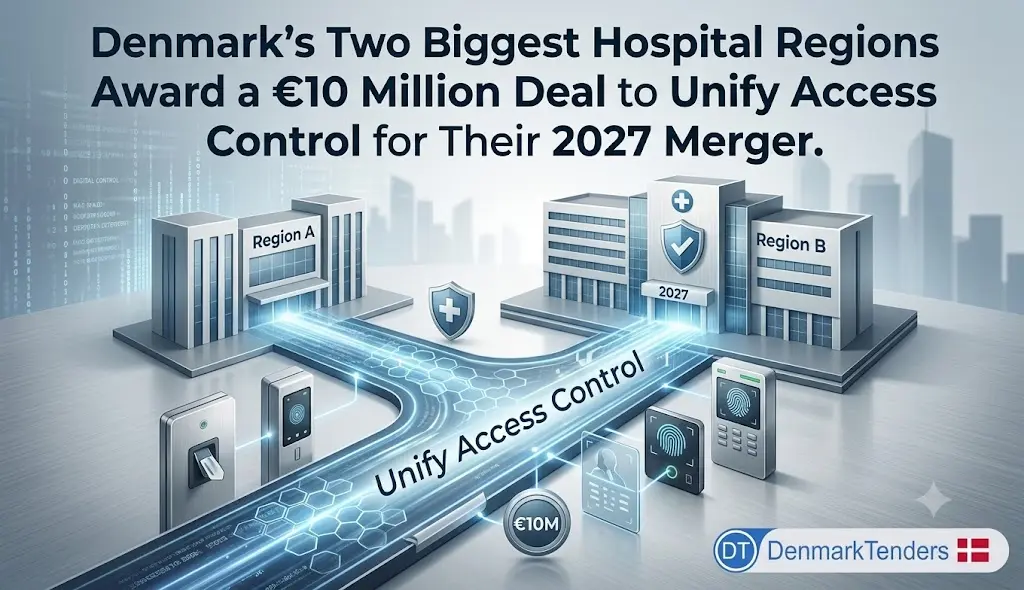
Denmark's Two Biggest Hospital Regions Award a €10 Million Deal to Unify Access Control for Their 2027 Merger
09 Jul 2026
Two Danish regional health authorities that together run hospitals across Copenhagen and Zealand have awarded a contract worth roughly 76.2 million DKK (about €10.2 million) to replace their separate identity and access management systems with a single platform. The winning bidder, Danish software firm Omada A/S, will build a cloud-based Identity Governance & Administration solution ahead of the regions' formal merger into a new "Region stdanmark" (Region East Denmark).IntroductionRegion Hovedstaden (the Capital Region) and Region Sjælland (Region Zealand) currently run their hospitals, diagnostic systems and administrative platforms on separate identity and access management setups. That is about to change: the two regions are merging into a single entity, Region stdanmark, and they need one standardised system to control who can access what across the combined organisation before that happens.The two regions have now jointly awarded that contract to Omada A/S, a Copenhagen-based identity governance specialist, in a deal worth just over 76 million DKK and running for nearly ten years once fully underway.Why This Contract MattersIdentity and access management rarely makes headlines, but in a healthcare setting it is foundational infrastructure: it determines which clinicians, administrators and systems can reach patient records, diagnostic platforms and administrative tools, and how quickly access can be granted or revoked as staff join, move or leave.This contract is also a case study in procurement timed around organisational change. Rather than merging two regions first and reconciling their IT systems afterwards, the buyers are using this contract to build the unified access platform in parallel with the administrative merger itself, aiming to have common infrastructure ready as the new region takes shape.Contract Timeline• Internal reference: 25059279• Notice published: 9 July 2026 (OJ S 130/2026)• Winning bidder selected: 23 June 2026• Contract concluded: 7 July 2026• First sub-delivery cutover: expected approximately 7 months after signing• Core contract term: 108 months from that cutover (115 months total from signing)Contract OverviewRegion Hovedstaden acted as group lead, running a negotiated procedure with prior publication of a call for competition, a process under Danish procurement law that allows the buyer to negotiate technical and commercial terms with shortlisted bidders rather than simply ranking sealed offers. Three tenders were submitted, all electronically, through the Mercell CTM procurement platform.The buyers reserved the right to award directly on initial tenders without holding negotiation meetings, and ultimately selected Omada A/S. The regions confirmed the award on 23 June 2026 and signed the contract on 7 July 2026.Key Contract Details Detail Information Contracting authorities Region Hovedstaden (group lead) and Region Sjælland, Denmark Winning bidder Omada A/S, Copenhagen (medium-sized enterprise) Contract subject Identity Governance & Administration (IGA) platform for user and access management, CPV 72200000 Procedure type Negotiated procedure with prior publication (competitive with negotiation) Legal basis EU Directive 2014/24/EU; Danish Udbudsloven (Public Procurement Act) Estimated value (ex-VAT) 155,000,000 DKK (approx. €20.8 million) Value of contract awarded 76,165,769 DKK (approx. €10.2 million) Contract duration 115 months (approx. 9.6 years), including a 12-month extension option Tenders received 3 (all submitted electronically) Award criteria Quality 60% / Price 40% EU funding None disclosed Covered by GPA Yes Contract signed 7 July 2026 Project ScopeThe core deliverable is a cloud-based Identity Governance & Administration platform, hosted by Omada in its own data centre, that will give every employee across the merged region a single, unique digital identity regardless of employment type. The regions want the new system to automate at least 60 percent of all system access grants through standardised data processes, replacing today's patchwork of manual approvals with one consistent ordering process.Delivery is structured in three phases. Phase A establishes the platform's foundation: connecting it to source HR data systems, migrating existing data, and onboarding technical applications including Active Directory, ServiceNow, CyberArk, BeyondTrust, Imprivata and Microsoft Entra ID, alongside designing business roles and training the regions' own staff to eventually manage onboarding themselves. Phase B extends this to the regions' business-critical clinical systems, including the shared Sundhedsplatformen (Health Platform) and core diagnostic systems, plus management-oversight and delegation features. Phase C completes onboarding of remaining user systems and finishes staff training so the regions can operate independently.Beyond initial delivery, Omada must provide ongoing hosting, operation, support and maintenance of the software, backed by a professional IT service management function for incident handling, plus on-demand consulting and training call-offs, such as building new connectors, for the life of the contract.About the Contracting AuthoritiesRegion Hovedstaden and Region Sjælland are Danish regional authorities responsible for public healthcare, running hospitals, diagnostic services and associated administration across Copenhagen and the wider Zealand area. The two regions are in the process of merging into a single entity, Region stdanmark, making this contract part of the practical groundwork, standardising shared digital infrastructure, that underpins that administrative consolidation.About the Winning CompanyOmada A/S is a Copenhagen-based identity governance and administration specialist, classed as a medium-sized enterprise. The company's selection for a near-decade-long, mission-critical access management contract for two of Denmark's largest healthcare regions reflects a specialism in the IGA category, an area of enterprise software focused specifically on governing digital identities and system access at scale. No subcontracting was declared.Procurement AnalysisProcedure: A negotiated procedure with prior publication was used, giving the regions scope to refine technical requirements with bidders, though they reserved the right to award on initial tenders without holding negotiation meetings at all.Competition: Three tenders were received, a reasonable field for a specialised enterprise software category where few vendors combine healthcare-scale identity governance with the ability to commit to a near ten-year service relationship.Award criteria: Quality carried 60 percent of the weighting against 40 percent for price, meaning the regions prioritised technical and functional fit over the lowest cost, appropriate for a platform this deeply embedded in clinical and administrative operations.Value gap: The awarded value of roughly 76.2 million DKK came in well under the regions' own estimate of 155 million DKK, though the notice cautions that the estimate reflects a broader forecast scenario over the full contract term rather than a directly comparable like-for-like figure.GPA status: The contract falls under the WTO's Government Procurement Agreement, open in principle to qualifying international bidders, though the winning vendor is Danish.Additional Procurement Facts• The procedure was not accelerated, indicating a standard timeline was followed.• No framework agreement or dynamic purchasing system was used; this is a direct services contract with a built-in 12-month extension option.• All communication in the procedure, including bidder questions, was required to run through the regions' electronic procurement system, with technical support available via Mercell CTM.• Bidders had to submit tenders in Danish, though screenshots or figures reproducing existing standard software could remain in English.• The notice flags that the contract may fall under Denmark's investment screening law, potentially requiring non-EU/EFTA-linked bidders to seek approval from the Danish Business Authority before signing.• The notice also flags that the procurement is subject to EU sanctions rules under Article 5k of Regulation (EU) No 833/2014, which bars awarding contracts to Russian or Russian-controlled entities.• Disputes or review requests fall to the Klagenævnet for Udbud (Danish Complaints Board for Public Procurement) in Viborg.Market & Industry PerspectiveIdentity governance has become a priority category for large public healthcare organisations across Europe, driven by rising cyber-risk in the health sector and stricter expectations around auditable, automated access control rather than manual approval chains. Denmark's regional merger adds a second driver on top of that: consolidating two organisations' IT estates gives buyers a rare opportunity to standardise on a single platform rather than integrating two legacy systems indefinitely.For vendors in this space, healthcare buyers represent a demanding but sticky customer segment: implementations are long, deeply integrated with core clinical systems like Sundhedsplatformen, and once embedded are costly to displace, which likely explains the near-decade contract term secured here.Economic SignificanceAt roughly €10.2 million awarded against a much larger ceiling estimate, this is a modest headline figure by major infrastructure standards, but the nearly ten-year term makes it a significant, durable revenue relationship for Omada, and a long-term dependency for the two regions. Enterprise software contracts of this length are relatively unusual in public procurement and reflect how deeply an identity platform needs to be woven into an organisation's daily operations before it can be considered stable.The contract also gives both merging regions a predictable cost basis for a category of IT spend, security and access administration, that might otherwise have been duplicated or renegotiated repeatedly through the merger process.Future Procurement OpportunitiesThe call-off consulting and training services built into this contract mean further individual orders, such as new system connectors or extended onboarding support, are likely to be issued to Omada throughout the nearly decade-long term. More broadly, as Region stdanmark takes shape, other shared-services contracts covering IT, administration and clinical systems may follow a similar pattern of consolidating what were previously two separate regional procurements into one.Opportunities for SuppliersWhile no subcontracting was declared at award, a platform of this scope, spanning HR data integration, clinical system onboarding, and ongoing IT service management, typically generates demand for specialist implementation partners, connector developers and training providers over its lifetime. Firms with healthcare-sector identity and access management experience in the Nordic market are best positioned to engage as the phased rollout progresses.What Businesses Should Watch• How the phased rollout, particularly onboarding of business-critical systems like Sundhedsplatformen in Phase B, proceeds through the regions' merger timeline.• Whether Region stdanmark issues further consolidated IT contracts as the two regions' systems continue to align.• Quality-weighted award criteria on enterprise software contracts, which reward functional fit and long-term service capability over the lowest bid price.TendersOnTime Procurement IntelligenceThis contract illustrates a pattern likely to recur as European public bodies merge or restructure: using a major IT procurement as the mechanism to standardise infrastructure ahead of, rather than after, an organisational consolidation. Building one identity platform for the merged Region stdanmark now avoids the alternative of integrating two separate legacy systems once the merger is already complete.The quality-weighted award criteria are also a useful signal. With 60 percent of the decision resting on quality against 40 percent on price, the regions treated this as a long-term platform choice rather than a commodity purchase, consistent with a near ten-year commitment embedded in clinical operations.For suppliers, the lesson is that specialised, long-duration public sector software contracts of this kind favour vendors who can demonstrate deep sector-specific integration experience, healthcare systems, HR data, identity standards, over those competing purely on upfront cost.Supplier Takeaways• Public sector mergers and restructurings can generate significant one-off IT consolidation contracts, worth tracking as organisational change unfolds across Europe.• Quality-weighted criteria, here 60/40 in favour of quality, mean technical and functional fit outweighs price in specialised enterprise software procurements.• Long contract terms, nearly ten years in this case, are increasingly used for platforms deeply embedded in clinical or operational workflows.• Call-off consulting and training provisions built into service contracts offer ongoing engagement opportunities beyond the initial award.• Danish and EU sanctions and investment-screening rules are increasingly explicit conditions in public procurement notices and should be checked early by any prospective bidder.Key Takeaways• Region Hovedstaden and Region Sjælland jointly awarded a 76.2 million DKK (approx. €10.2 million) contract to Omada A/S for a unified identity and access management platform.• The contract supports the two regions' merger into a new Region stdanmark, replacing separate legacy systems with one standardised solution.• The contract runs for approximately 115 months (nearly ten years), with a further 12-month extension option.• Three bids were received through a negotiated procedure weighted 60% quality and 40% price.• The platform will onboard business-critical clinical systems, including the shared Sundhedsplatformen, alongside core administrative applications.ConclusionThis is not a contract that will attract broad public attention, but it reflects a structurally important moment for Danish regional healthcare administration: two large public health authorities standardising their digital access infrastructure as they merge into one. Omada A/S now carries responsibility for delivering and running that platform for the combined Region stdanmark for close to a decade.Frequently Asked QuestionsQ1. What is Identity Governance & Administration (IGA)? It is a category of enterprise software that manages digital identities and controls which systems and data each user can access, automating approval, review and revocation processes rather than handling them manually.Q2. Why are two separate regions awarding one joint contract? Region Hovedstaden and Region Sjælland are merging into a new entity, Region stdanmark, and are using this contract to build one standardised access management platform ahead of that administrative consolidation.Q3. Why was quality weighted more heavily than price? For a platform deeply integrated with clinical systems and running for close to a decade, the regions prioritised functional fit and technical capability, weighted at 60 percent, over the lowest purchase price, weighted at 40 percent.Q4. Is this contract funded by the EU? No. The notice confirms the project is not financed with EU funds, though it is governed by EU Directive 2014/24/EU and covered by the WTO's Government Procurement Agreement. Q5. Did any subcontracting take place? No subcontracting was declared by Omada A/S at the time of award.
View Details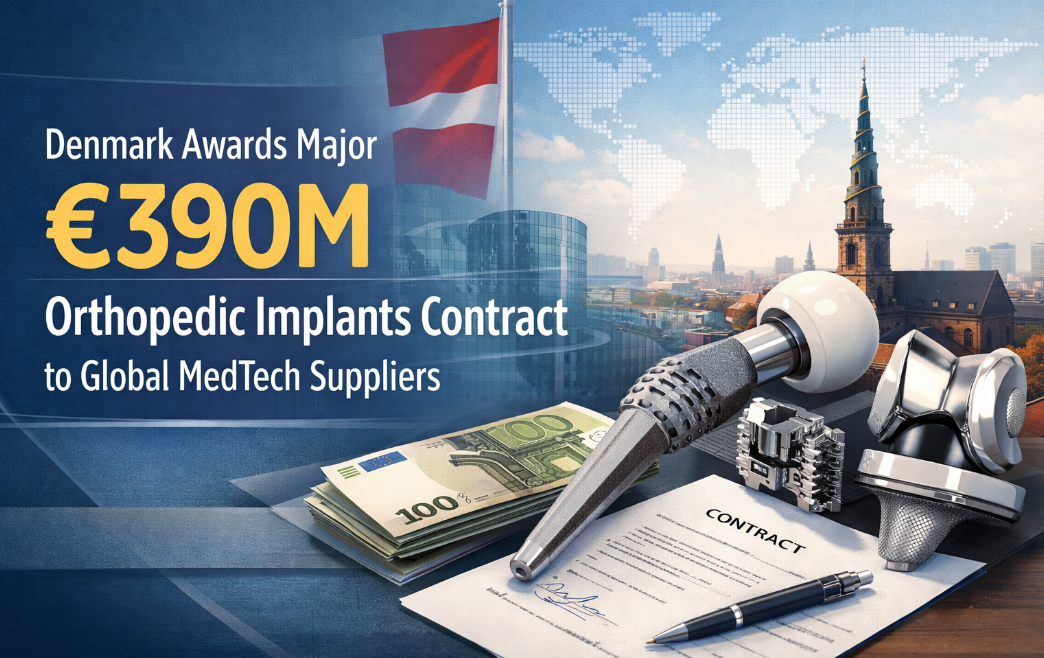
Denmark Awards Major €390M Orthopedic Implants Contract to Global MedTech Suppliers
18 Feb 2026
IntroductionThe Capital Region of Denmark has announced the contract award for a large-scale medical supplies tender covering hip, knee, and shoulder implants and bone cement. The framework agreement, signed on 11 February 2026, brings together leading global MedTech manufacturers to support orthopedic surgeries across the region’s healthcare system.Contract Details and ScopeThe awarded tender has an estimated value of DKK 2.89 billion, making it one of the most significant recent government healthcare procurement contracts in Denmark. The contract focuses on the supply of orthopedic implants and related surgical instruments used in hip, knee, and shoulder alloplasty procedures, as well as bone cement for both primary and revision surgeries.Key product categories include :-Cemented and uncemented femoral stems for total hip arthroplastyRevision stems and acetabulum cupsPrimary and specialized knee prostheses, including mobile and fixed-bearing systemsPatellofemoral and shoulder prostheses, including reverse shoulder implantsClosed-system bone cement for orthopedic proceduresThis procurement ensures long-term supply continuity for hospitals across the Capital Region, supporting growing demand for joint replacement surgeries driven by aging populations and increased mobility needs.Entities InvolvedThe contracting authority is the Capital Region of Denmark, headquartered in Hillerød.The framework contract has been awarded to a consortium of global and regional suppliers:Zimmer Biomet Denmark ApSStryker DanmarkJohnson & Johnson MedTech (Janssen-Cilag A/S division)Viking Medical Scandinavia ApSSmith & Nephew A/SOsteotec NordicHeraeus Medical GmbHWaldemar Link GmbH & Co.Industry and Healthcare ImpactThis procurement news highlights Denmark’s continued investment in advanced medical technologies and long-term healthcare planning. Joint replacement procedures are among the most common orthopedic surgeries in Europe, and reliable access to implants is critical for reducing waiting times and improving patient outcomes.The framework agreement also reflects strong competition in the global orthopedic implants market, where innovation, durability, and clinical outcomes are key evaluation criteria.Background on SuppliersThe winning companies represent some of the world’s most recognized orthopedic device manufacturers, with extensive experience supplying hospitals across Europe and globally. Their combined expertise spans implant design, surgical instrumentation, and biomaterials.ConclusionWith the framework now in place, hospitals in Denmark’s Capital Region are expected to begin phased procurement under the agreement. The contract reinforces the region’s commitment to high-quality orthopedic care while ensuring stable long-term supply for joint replacement procedures.#ContractAward #TenderResults #ProcurementNews #AwardedTenders #GovernmentContracts #Denmark #DenmarkHealthcare #HealthcareProcurement #MedicalSupplies #OrthopedicImplants #JointReplacement #HipReplacement #KneeReplacement #ShoulderReplacement #BoneCement #MedTech #HospitalSupplies #PublicProcurement #EuropeanHealthcare #MedicalDevices
View Details